Monday, September 28, 2020

52 Ancestors in 52 Weeks. Week 38. Prompt - Map It Out

52 Ancestors in 52 Weeks

Week 38

Prompt – Map it Out


Malcoci, Tulcea District, Dobrudscha, Romania
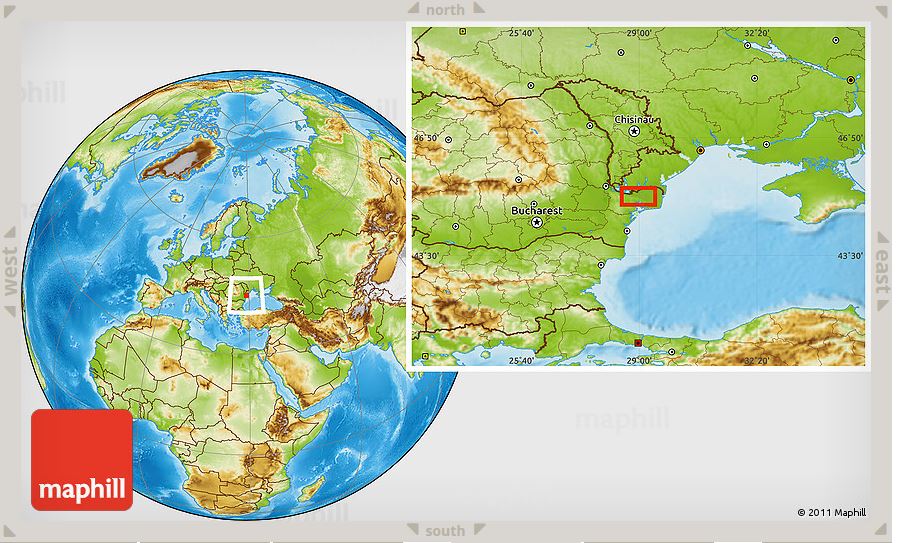
 
It was early 1840's when the first German Colonists set foot in the Dobrudscha District.  Strangely they were not from Germany but from Bessarabia.  And those Germans had only arrived in Bessarabia in the previous 40 years from their homeland of Germany and in some cases from Alsace, France.

At this time The Dobrudscha Area would have belonged to Turkey and under The Ottoman Empire. These Bessarabians left their allegiance to the Czar of Russia and pledged an allegiance to a Sultan of The Ottoman Empire!  Of course, as in most immigration, the German immigrants had to be in good standing, not have been accused of crime, and the ability to work in farming and other crafts.

Bill's 2X Great-grandfather was Ignatius Hoffart.  While looking for any information on Malcoci, I discovered the website, Wild-Danube-Delta.com .  It had a short history of the city.

“The village was founded in 1843 by 25 German families, making it the first of a number of villages founded by German colonists in Dobrogea, led by Ignatiou (sic) Hoffart.”

Further I found this translation of Romanian Parliament Debates dated 7 May 2007.  It was about the old Catholic Church in Malcoci and it's demise.  Again it mentioned Ignatius Hoffart as founder. 

 Two separate on-line sights have listed Ignatius Hoffart as founder of Malcoci however I have not verified that by other sources.  Ignatius Hoffart married Marion Frank and they had several children. Their third child was Jacob Hoffart who is Bill's great-grandfather. 

Jacob and Eva were married 25 October 1885 in Romania.  They had 10 children and all were born in Romania.  One child died in Romania.   In 1913 Jacob and Eva Hoffart and 8 of the 9 remaining children immigrated to Canada.   They left from Antwerp, Belgium aboard a vessel by the name of S.S. Montreal.  They arrived in Quebec, Canada on 20 May 1913.  The 1921 Canada Census has Jacob and Eva settled on a farm in the area of Benson, Saskatchewan. 

The child who did not come at the same time as his parents was Rochus who is Bill's grandfather.  There is a family story that he fell ill at the time of boarding and was left behind.  He was hardly a child, he was 23 years old.  I am sure they weren't too worried about him being held back.  His immigration started with his departure from Glasgow, Scotland on 31 Jan 1914 arriving at St John, New Brunswick, Canada on 11 Feb 1914.   I am not sure where he lived during the 8 to 9 month stay.

Rochus' soon to be bride was Marian Gross was born in Romania and immigrated to Canada a few short months after Rochus.  Marion Gross was a passenger aboard the ship Dwinsk departing from Libau, Russia on 24 Mar 1914 and arriving in Halifax, Nova Scotia, Canada on 4 Apr 1914.  It feels like it was an arranged marriage but I do not know that for sure.  Rochus and Marion married a few months later on July 22, 1914.

From the time of their marriage until 1919 Rochus worked as a “boilermaker helper” in Aberdeen, South Dakota.  One or two of their first children were born in United States.  I have not been able to verify that.  None the less Rochus was in USA and at that time the draft was compulsory for WWI in USA.  He filled it out and dated the card June 5, 1917.  WWI ended and Rochus, Marion and family moved back to Canada.   His Border Crossing Card was filled out on 24 Jun 1919 at Big Muddy Crossing.  According to this card “the object of coming to Canada was to make a home taking up on land.”  He came across with $1000.00 in cash and belongings valued at $1060.00. He was admitted to Canada.

He took out his first homestead on Jun 7 1919 (yes that was two weeks before they moved to Canada) which was just north of Big Muddy Lake,  However part of his homestead was under water. He gave up this land and in May of 1929 he applied for his second homestead.  Their family had grown to 8 children. Bill's father, Anton Hoffart was born in Minton, Saskatchewan and was their 5th child. 

Bill's 1st cousin once removed is John Hoffart who is still living in Regina today.  He wrote this about the family's move to Neudorf.  Regina Hoffart is Anton's younger sister who is still living and in Saskatoon.


Bill's father, Anton (Tony) Hoffart married Clara Jahnke in Killaly, Saskatchewan in 1952 and they moved to Saskatoon where there children were born.  Their oldest son, William (Bill) Hoffart was born in Saskatoon.  Bill and I married in 1975 in Saskatoon.  We lived a year in Saskatoon and then moved to Regina for Bill's first engineering job.  We moved in the spring of 1989 to Edmonton, Alberta.  In September of 1996 we moved to Calgary, Alberta.  In the summer of 2015 we retired to Kelowna, British Columbia. However we moved back to Calgary in May of 2019.

The Hoffarts in my family tree begin in Germany or maybe Alsace, France. They immigrated to Bessarabia, to Malcoci, to Canada with a short time spent in Northern United States before settling in Benson, Saskatchewan.  Rochus Hoffart settled in Big Muddy / Minton before they moved north to Neudorf and then on to Regina.  In the next generation (Tony Hoffart) moves from Killaly to Saskatoon where he lived out the rest of his days.  And in our generation Bill and I moved from Saskatoon to Regina, Edmonton, Calgary, Kelowna and back to Calgary.  Our children, lived in Regina, Edmonton and Calgary.  Jackie moved to Vancouver for university.  Upon graduation she  moved to Omomichi, Japan and then to Tokyo, Japan and then on to London, England and came back to Vancouver, British Columbia.

The Hoffart name has travelled westward landing almost 1/2 of the way around the globe. Does it end there?  Who knows?

Wendy


Sunday, September 20, 2020

52 Ancestors in 52 Weeks. Week 37. Prompt - Back to School

52 Ancestors in 52 Weeks

Week 37

Prompt – Back To School


My 11 year old granddaughter was so happy to be going back to school after being away for almost 6 months due to COVID.  It was so boring.  


Apr 9, 2020. 

Just weeks into the quarantine.


May 18, 2020 - Kelsey expands her bubble to include Grandma and Grandpa.


June 15, 2020 - Hanging out with grandma on the deck.


 July 1, 2020. Exercising while working on a puzzle book.


 July and chilling with Alanna's dog, Milo. August swinging at the park and counting the days till school starts.


Back to school shopping went ahead despite not knowing if the school would open to children.  She got her supplies from the school list and a new backpack.  Her 1st day of back to school clothes were laid out days before school started.  She had her hair colored red because well, you know, one needs a new look for back to school.  If she was nervous about the pandemic in school, she did not say so to me.

Parents had the agonizing decision to make whether to send them back to school.  Teachers were similarly wrestling with their return to school with the added urgency of their need to support themselves.  Choices were given to the parents. They could send them back to school or home school them.  However for most parents there was no choice at all.   They could not quit work and stay home to school their children.  And I know in the case of my granddaughter, she did not want to do virtual schooling at home.  She did not like it.

I had the privilege of picking her up after her first full day of school.   I believe she called it a safety day and only half of her class was there that day.  They learned all the procedures and rules they needed know to be in school during a pandemic.  Masks had to be worn while in the hall or in areas where there are many children together including wearing a mask on the bus.  Apparently their is no social distancing on her bus. They sit side by side but in assigned seats.   So many children so few buses or is it drivers?

Her classroom has all desks filled.  Perhaps they are distanced.   It was once suggested that they might have an empty desk beside them to put their coats, backpack etc onto.  They do not have lockers during the pandemic for some reason.  My guess is that it would cause the children to be too close to each other.  So all of her stuff goes on the floor under her desk.  The teachers move while the children stay in their classrooms except in those special classes such as gym, drama etc.   She was most disappointed by the lack of team sports this year.   During gym class their teachers scramble to find non contact sports for the children to participate in.

They eat their lunches at their desks in their classrooms and it sounds like they have two shifts so that not all the children go out at once.  Hand washing or as it is called at school, hand hygiene is the most important thing for the teachers and children.

She brought home a copy of the self screening questionnaire that she has to do everyday before going to school. 

When I picked her up after her first full day, I was expecting to hear all about the new rules. She did not dwell on any of those things.  She proceeded to tell me about her homeroom teachers, her other classmates in her new grade 7 class.  She was quite put out with the 6 day schedule.  Remember Day 1 through Day 6 and not Monday to Friday Schedule?   She thought that was a dumb idea.  She is worried about trying to remember what day it was so she can take the right books to school.  She was disappointed when she did not get her preferred optional classes.  All in all she was happy to go back to school.

Going back to school during COVID-19 was not about the mask wearing, the physical distancing, hand washing and non sharing.  It was about all the usual things that students talk about when going back to school.  That is teachers, classmates, classes, schedules and routine.   It is the routine that they all have missed the most during the pandemic. 


Kelsey after her 1st day of school.  All smiles!


Wendy


Saturday, September 12, 2020

52 Ancestors in 52 Weeks Week 36. Prompt - Labour


52 Ancestors in 52 Weeks

Week 36

Prompt – Labour


Apron is a garment worn to protect clothes or even the body from the work one is doing.

Did you know it was mentioned in the first book of the Bible.  It says in Genesis 3:7: “And the eyes of them both were opened, and they knew that they were naked; and they sewed fig leaves together, and made themselves  aprons.”  So perhaps the first clothing ever worn was an apron!

Into the middle ages aprons were worn by men that denoted specific trades.  Heavy leather for the forger or heavy dark fabric aprons for perhaps a meat cutter trade or cobbler.

In the 19th and 20th century the apron became the necessary garment of women.  They needed to protect their clothes of which they had few.   It was part of her outfit.   Apron on and the day begun.   In one of my Mennonite readings I discovered that in actuality the apron was a multi use garment.  For example; collecting the eggs from the hen house to take inside, gathering wild flowers from the garden, or to collect peas when they were shelled on the porch, to hide a shy child or wipe away the tears of a child, a handy pot holder, a quick duster, carry kindle to the stove, to hold a load of laundry to the clothes line or perhaps the clothespins, dry her hands and maybe mop the brow from the hot elements of the kitchen.

Until the 1960's the apron was worn with pride.  Early on in the twentieth century full length ones were worn.  Most likely ironed and starched. 

Circa 1920 - Emilie Jahnke; Bill's paternal Great Grandmother.


   Circa 1942. Bill's Great Aunt Dora Posing on Front Deck.


The 1930's and 40's the apron was made from remnants of fabric found around the house such as tea towels, kitchen curtains or flour sacks.  In the 1950's the apron was in it heyday and aprons were made as an expression of who they were.  Frills, rickrack, appliques, embroidery and special seasonal fabrics were common.  Practical aprons worn during the daytime while prepping food and a clean embellished one put on as soon as the man of the house came home from work!

  1952 October 6, Clara Hoffart's Wedding Day. The Apron is Somewhat Frillier

By the mid 1960's and the advent of women's liberation, the apron became the symbol of the repression of women, being tied to the relentless housework and overall domesticity not to mention the symbol of being tied to the stove at the beck and call of men.  The thankless labour of being a “stay at home mom”.

I grew up in between these two apron eras.   Thus I have wonderful memories of my grandmother wearing her apron and the delicious meals and desserts she made for us.  It must have been a labour of love. It is a warm fuzzy feeling. 


 My Grandmother Mary McLaughlin in 1980's.


My father was a "ham boner" at the meat packing plant.   He wore a white apron.  I only got to see him wear it when he returned home after being cut by his sharp knife.  Believe me when I say it told a story of blood, guts and gore.  My mother was not a stay at home mom when I was a child.  She went to work full time in 1962 or 1963.  I did not witness my mother being tied to the stove so to speak.  In fact she worked as a cook and wore her white uniform with a brilliant white apron with pride and a symbol of self reliance.

My first home economics sewing project of the late 1960's was to sew a simple apron.  I remember that it was made of yellow gingham material and rick rack edging.  My sewing skill was non existent.  It was our apron to wear in home economics for our food prep classes.  At that time most of the women in my life wore their aprons around the house when cooking. 

Shortly after I was married in 1975, my mother in law, Clara Hoffart, made me a fancy apron with pinafore.  I still have it to this day but can't remember the last time I wore it.  I have a photo of me icing Jill's 1st birthday cake which was protecting my "got home from work clothes and the people were coming to the party soon and no time to change clothes".  


 1979 - Icing Jill's 1st Birthday Cake.Got to love the Perms of the 1970's!


 I am well aware of the 1950's symbology of women being tied to their stove in repression, but for me wearing an apron is somewhat nostalgic.  

The following are some of the pictures I found in my album of the women and some men in my life wearing their aprons. Enjoy. 


My Blind Paternal Grandmother Elisabeth Peters in her Gingham Apron. 


Unknown date. To the best of my knowledge; Lt to Rt. Ruby (Mary's Daughter) Shirley (Katie), Mary who are Elisabeth Peters' daughters. 


Circa 1930's. My maternal great grandparents. Maria and Andreas Krikau. 


Circa 1965 - Bill's maternal grandmother, Ida Bachmann. Even at a picnic the apron is necessary. 


 1996 - Jill Matish alone in the kitchen cleaning Christmas dinner dishes.

1997 - Jackie Hoffart in Dairy Queen Work Clothes.
 2000 November. My granddaughter, Alanna Hoffart, rocking her Easy Bake outfit. 


My brother, Rob Peters and daughter, Alyss. It's barbecue time!


Circa 1992. Bill is ready to carve the Christmas turkey. He is wearing a borrowed Christmas apron. 


Wendy

Monday, September 7, 2020

52 Ancestors in 52 Weeks. Week 35. Prompt - Unforgettable


52 Ancestors in 52 Weeks

Week 35

Prompt – Unforgettable


On November 22, 1963 I was in grade 3 and about 8 years old.  I was at home sick from school that day.  The television was on and I can remember the announcement that President J.F. Kennedy had been shot. It had interrupted whatever show I had been watching while laying on the couch.  I didn't fully understand who he was.  I remember thinking that he was someone important because newsmen were wiping tears away in front of the camera when they announced he had died.  The television seemed in chaos.  Fast forward a week or so and I watched the newscast show on highlights of JFK's funeral.  He had small children that attended the funeral.  All I could think about was what it would be like if I lost my father and had to attend his funeral.  The reality of my mortality was taking shape and I couldn't stop thinking about death and dying for some time. 

 In December of 1967, the first human to human heart transplant had occurred in South Africa.   The night time news was shocked by this medical miracle.  I guess some thought Dr. C Barnard was playing God by delaying an inevitable death.   I was 13 and thought that this was the most miraculous thing I would ever see.  It was mind boggling.  It sparked my imagination and curiosity of what else could be done.  This was only the beginning of medical advancements in my lifetime.  For heaven's sake when I took nursing there was just x-ray machines and ultra sound machines had just come into being the next big thing. 

 July 20, 1969 American Astronauts landed on the moon.   Neil Armstrong was the first man to walk on the moon.   I was 15 years old and unlike many, I did not witness it live on the television but listened to it on a car radio.   I belonged to The Charlie Brown All-Stars midget girls fastball team and we were coming back from a ball tournament.  Our coach had half the team in his station wagon.   I remember sitting in the back with several other team members.  Our coach shushed us and turned up his radio as we listened to the radio announcer countdown to the touchdown.  We all cheered loud.  We knew it was going to be an unforgettable historic moment in our life that we would tell our children and grandchildren.  I cut out all of the newspaper articles and pasted them into a scrapbook.   I wanted to preserve the moments of this time.  It was the beginning of my need to preserve my mind boggling events for future generations. 

 September 11, 2001. or 9/11.  It was suppose to be just another ordinary day.   At first it seemed that way.  Our radio station said that a plane had hit one of the twin towers in New York.   I turned on TV and flipped the channel to CNN.  Just in time to see live the second plane crash into the second tower.   It is an image that I and millions of others will never forget.  I worked at a doctor's office and had to go to work.   As patients came in they kept us posted on the latest.  My stomach sank at the news of the collapsed towers.  The whole thing was too much to absorb.  It was hard to make sense of it and deaths of all those innocent people.  How could one group of people do this to another?   The world would never be the same but we just didn't know it then.  It was so traumatic that families connected to each other by phone in record numbers.   I felt that the world just became a little less safe and I did not like that feeling of loss of innocence. 

 I believe when we look back on the year 2020 we will see how Coronavirus changed our world.   The global pandemic brought more than the deaths by the novel virus.   It changed how we lived.   Schools closed and work places shut down,  We stayed home in our isolated groups.  We needed to figure out our lives in a new way.  The economic impact was immediate and everyone felt it.   Since it still is an ongoing concern there will be more to talk about it for years to come.


These are just a few of the unforgettable world events in my life time that impacted me in a profound way.  We all have these moments in time where we can say what we were doing at that time it happened.  Every generation has them. 

Wendy
Monday, August 31, 2020

52 Ancestors in 52 Weeks. Week 34. Prompt - Chosen Family

52 Ancestors in 52 Weeks

Week 34

Prompt - Chosen Family


I know very little of The Dueck Family Ancestry.  Elisabeth Dueck is my father's mother's maiden name.  There seems to be many ways to spell this name.  Alternatives include:Dyck, Dück, Dick, Dieck, von Dyck, van Dyck, von Dick, van den Dyck.  Apparently Duck (should have umlauts over the U) is German slang for shirker or cheat. Not in my family!
 
The Dueck line in this case begins with Jacob Dyck born about 1729 in The Vistula Delta, Poland. During his life, Poland was subdivided and the area he lived in became West Prussia.  According to GRANDMA Online, (Genealogical Registry and Database of Mennonite Ancestry) he died April 18, 
1792 in Neustaedterwald, Gross Werder, Prussia.
 

Jacob Dyck married someone known only as Sara and they had 6 children.  Their second child named Leonhard Dyck was born 1790 and in Neustaedterwald, West Prussia.  This is Elisabeth Dueck's 2 times great grandfather.  Leonhard Dyck married Katarina Rempel.  They married August 1,1801. Leonhard was 30 years old which seems older than usual for a man's first marriage.  This was Katarina's second marriage.  She had 3 children from her first marriage.   Leonhard and Katarina had two children together.  Leonhard Dyck died August 18, 1810 at the age of 40 years and just 9 years after being married.  He died in Stobbendorf, Gross Werder, Prussia.  These places are quite close together and about 40 kilometers south east of present day Gdansk. On the above Map of The Vistula Delta these two places are in Rosenort. 

Leonhard and Katarina Dyck first born was Leonhard Leonhard Dyck and his birth is listed as “abt. 1802” which is based on the marriage date of 1801. Again I presume he was born in Stobbendorf, West Prussia given that is where his father died 9 years later.

Leonhard Leonhard Dyck married Justina Hiebert. The 1835 Molotschna Census lists him at Lichtenau #27, and says he came to Russia in 1829. He was the Dueck / Dyck who immigrated to Russia from West Prussia. He moved to Molotschna colony.  This colony was the second Mennonite colony in Russia which began in 1804.

 Leonhard Leonhard and Justina had 7 children.  Their youngest child was Johann Dueck / Dyck born April 16, 1844.   Johann married Helena Peters September 2, 1866 in Russia. They had 15 children.  The first 5 were born in Russia.  They immigrated to Canada.  Their departure was from Hamburg on July 2, 1875 and they arrived in Quebec on July 19, 1875.  They travelled on to their colony in Manitoba.  The youngest two children died on the same day, August 18, 1875.  Just one month after arrival.  Their 6th child was born in Manitoba on September 6, 1875.  He died less than one month later on October 1, 1875.  So tragic.  Johann Dueck died November 17, 1909 in Saskatchewan (Swift Current Colony).  Helena died March 3, 1918 in Saskatchewan.

Johann and Helena's 9th child was Elisabeth Dueck / Dyck.  She was born January 11, 1881 in Manitoba. Her birth place has been listed as Borden, Manitoba and West Reserve, Manitoba.  This is my paternal grandmother.  However in this Dueck Ancestry line she is the first Dueck / Dyck in my ancestry line. 

                                      Elisabeth Dueck (1881 - 1972) 

 Elisabeth Dueck married Franz Peters on February 2, 1902 in Blumenthal, Saskatchewan, NWT.  This was in Hague, Saskatchewan.  They had 12 children.  My father, Jacob Peters was their 9th child born March 28, 1917 in Hague, Saskatchewan.

Elisabeth and Franz moved off the farm and into Saskatoon in the late 1920's.  Franz Peters died April 15, 1952 in Saskatoon.   Shortly after he died, Elisabeth and a few of her children moved out to Vancouver.  Elisabeth died January 16, 1972 in Vancouver.

I chose to explore the Dueck / Dyck family because it is a branch of my family that I know so little about.  I want to go back over this family line and learn more.  There is always more to learn.  This is just a synopsis.


Wendy


Saturday, August 22, 2020

52 Ancestors in 52 Weeks Week 33 Prompt - Trouble Maker

52 Ancestors in 52 Weeks

Week 33

Prompt - Trouble Maker


In general I do not think of Mennonites as trouble makers.  Their strict religious beliefs hardly leave room for troubles.  Further, Mennonites use a very effective tool in the way of punishment and that is 'excommunication”.  Upon excommunication, the errant member is excluded from all services of the church.  This includes communication with church members and often includes their own family.  They are shunned (boycotted) and not helped as they had been in the past in their communal colonies.  For example harvesting their crops alone without the use of communal harvesting machinery could cause them to lose the crop. Their businesses are boycotted which often meant that their business would surely fail.

This Newspaper Article from The Regina Leader Post on November 13, 1914 gives us a bit of insight of one cause and fall out of the excommunication of Jacob J. Heinrichs. He is not my ancestor as far as I know. 

Jacob J. Heinrichs used the court system to collect on business debt, failing to obey the Mennonite church rules by using a legal system outside of the Mennonite colony. But this excommunicated Mennonite trouble maker took it one step further by suing the bishop who excommunicated him.  What did he have to lose?  He was already excommunicated!  I am not sure of the outcome of this case.

The Mennonites keep only those individuals who obey and commune in social harmony with their colony.  The misbehaving heretical individuals are swept away in order to keep the Mennonites homogeneous in their beliefs with no room for individual interpretation.

This happens less often now but certainly it was a thing at the end of the 19th and beginning of the 20th century.  Despite the colony and their bishops best efforts their members slowly assimilated to the world outside of the colony.  This resulted in “The Old Colony Mennonites” of Saskatchewan to once again pack up and move south to Mexico in the 1920's.  Just like the move from Prussia to Russia and then on to Canada; they were in search of religious freedom that allowed them to speak their German and more importantly, teach their own children in their language and with their own curriculum as set out by the Mennonite Teachings. 

My father and his parents were not among the group that moved on to Mexico.  My father and some of the family eventually moved to a house in Saskatoon.  I am not sure The Mennonite religion played a part in their lives afterwards.


Wendy

Friday, August 14, 2020

52 Ancestors in 52 Weeks. Week 32 Prompt - Small

52 Ancestors in 52 Weeks 

Week 32

Prompt - Small


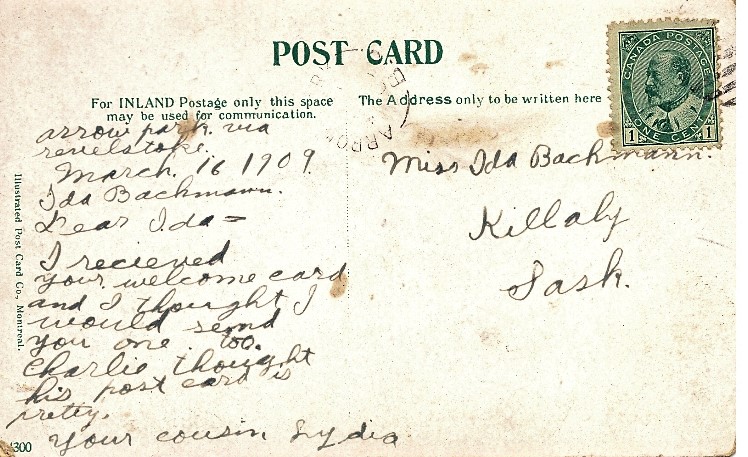
You know a place is small when you send a postcard and just address it to a person and their village name!


Killaly is a village in Saskatchewan where Bill's mother, Clara Carolina Jahnke was born.  She was actually born on the farm but her birthplace is noted by both Section,Township, Range, and the village of Killaly.  She was born March 11, 1928 to Ida (nee Bachmann) and Arthur Jahnke.  Ida Bachmann was born in Winnipeg. 

                          Ida and Arthur Jahnke - Circa 1920

 Ida's parents were August and Wilhelmina (nee Fesser) Bachmann.  Wilhelmina Fesser was born in Theodorshoff,  Austria and immigrated to Winnipeg through New York in 1889.   August Bachmann was born in Magdeburg, Germany and immigrated to Winnipeg in 1887. 


In 1958, The Melville Advance did a district profile of Wilhelmina Bachmann for the local newspaper.  She described her new home of Winnipeg like this. 


Wilhelmina and August met through the Lutheran Church they both attended in Winnipeg.  In the same newspaper article she described how she met her husband. 

 However after 6 years, August Bachmann grew weary of “city life” and they bought a farm east of Winnipeg where they lived for the next 5 years as they started their family.

In 1905 The Bachmann's sold their farm east of Winnipeg and moved off to Killaly, Saskatchewan. Apparently when they arrived by train in 1905 there was only 40 people who lived there.  Mostly immigrants from Austria, Germany and Russia looking for homesteads.  Melville was non existent.

I wondered why they chose Killaly?  Clara's 2nd cousin (remember Harvey Jahnke who was also her 3rd cousin) stated that Wilhelmina's father, Daniel Fesser was already homesteading in the Killaly area . Daniel Fesser's wife, Karolina was running a boarding house out of Neudorf.   Neudorf is a small village just 14 kilometers west of Killaly.   Also Wilhelmina's younger sister who was married to a Peter Wendel was homesteading land in Killaly.  Wilhelmina's brother, John Fesser was also in Killaly building homes among other buildings.   It was a family thing I guess. I understand this.

In the book “The Ties That Bind Melville'83” the following excerpt is written about The Fesser / Bachmann's family ties in Killaly.

 What is it about fire in the small Saskatchewan villages and towns?  They are resilient if nothing else.

August and Wilhelmina's children grew up in the small village of Killaly.  The first school was built in 1905. It was a one room school.  August Bachmann was on the Killaly school board as Secretary of the school. In 1912 a 'teacherage' was added and 1916 the second room was added.   In 1926 the high school room was added to complete The Killaly School.   It stood as the school until a new 3 room school was built in 1954.

The first Lutheran Church was built in 1926.  It became the Evangelical Lutheran St. John's Church of Killaly.  Among the 12 charter members of this church, there was August Bachmann and his son in law, Arthur Jahnke.  Arthur married August's daughter, Ida Bachmann.  Arthur Jahnke served on the church council for 27 years.  Arthur and Ida Jahnke are Bill's grandparents.  Due to dwindling population in Killaly, better means of transportation and better roads, St. John's Killaly closed in 1968 and demolished several years later.

Bill's sister, Norma tells the story of the day their family went to Killaly to pack up Grandpa Jahnke and his belongings to move him to live with them in Saskatoon.  It was around 1974 or so. His wife, Ida Bachmann died and 1972 and Clara wanted her dad to be with them.  As they were loading the car with Arthur's belongings and getting ready to depart Killaly, workers were in the process of tearing down St. John's Church.  Arthur was taking a last look as the top of the church came crashing down breaking the cross that had stood at the top of the church.  Arthur said to the family that now he definitely had no reason to stay.  Oh the heartbreak!  They sold the scraps of the church for 500.00 dollars.

Villages come and go.  In 1958 according to that same newspaper article on Ida Bachmann, the village was about 200 people.   The Ties That Bind written in 1983 states that Killaly population was gradually declining to it's present population of 300.  Using google I found the following chart on it's population.

 Killaly was and still is a very small village.  Yes it still exists.  The village of Killaly was incorporated in 1909.  Bill's maternal ancestors were there from the start.  I have been their twice.   The first time was for Arthur Jahnke's funeral in May of 1979.  The second time was in 2008 when we took Bill's mother back to Killaly and area so she could show us her first home and village.


Wendy

52 Ancestors in 52 Weeks Week 18 Prompt - Institution

2025  52 Ancestors in 52 Weeks Week 18 Prompt – Institution Daniel Fesser (1844 – 1933). He is Bill's maternal 2 nd great-grandfathe...