Friday, June 21, 2024

52 Ancestors in 52 Weeks Week 23 Prompt - Health

2024

52 Ancestors in 52 Weeks

Week 23

Prompt – Health

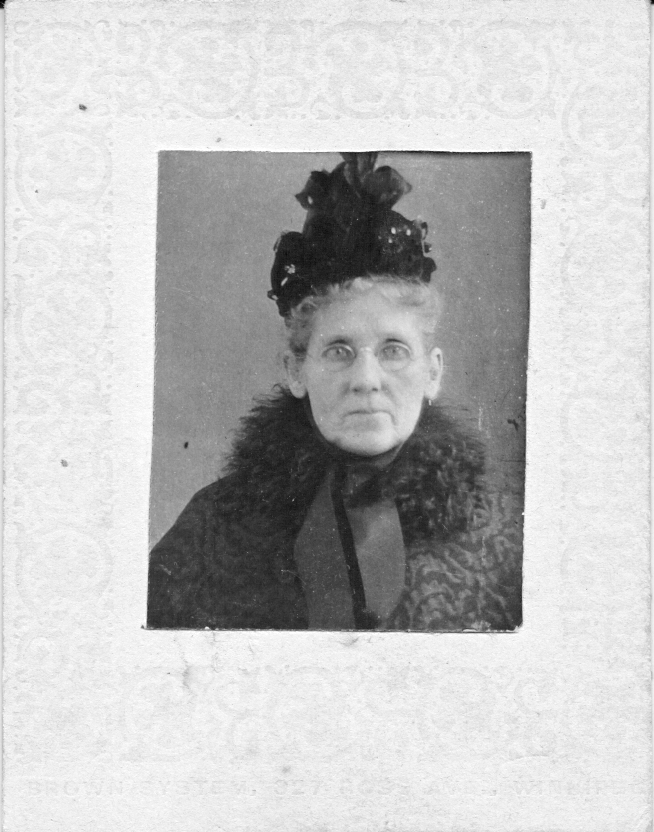
Mary McLaughlin - June, 1988
I was looking through photographs (as I often do) and found this photograph of my maternal grandmother – Mary McLaughlin. It was dated June 1988. I did not take the photograph and in fact I can't remember how it became mine.

I vaguely recalled that she suffered a stoke sometime in the summer of 1987. Thus when I saw this dated photograph of June 1988 she seemed to be using both hands to cut the strawberries. I didn't think that was possible. I realized I did not know how grandmother McLaughlin's last few years had unfolded. I had lived away from home for over 10 years. I was busy with my young family. I decided to ask my sister, Bonnie about it. Could she fill in grandma's story of her last few years for me?

Mary McLaughlin (nee: Krikau) was born on June 8, 1903 in Warenburg, Samara Province, Volga Valley, Russia. In January of 1987 Mary lost her daughter, Vivian (my mother). It had to be difficult for her.

1987 was the year that Bonnie recorded her oral history about the Krikau family and how they came to Canada from Russia.

It seemed like grandmother was quite healthy in the early part of 1987, In June 1987 she turned 84 years old and celebrated at her son - Uncle Wally, Phyllis and family in Ontario. 

Mary McLaughlin - June 8, 1987 - 84th Birthday

 Bonnie wrote this about our grandmother.

 
In July while Bonnie's family was getting ready for Lynn's baptism, Bonnie was informed that grandmother was being taken to St. Paul's Hospital for incontinence and confusion. Grandmother had suffered a stroke. Grandmother would never go back to her home after this. Shortly after she was transferred to University Hospital Geriatric Care. Bonnie said she had gone to visit grandma and a pile of wash clothes were on a table in front of her and she was struggling to fold them. Bonnie also realized at this time that the stroke had taken grandma's language.

Several weeks after being in the University Hospital she was transferred to a private home with 24 hour nursing care. Bonnie said that it was a bi level home and “the with it clients “ were upstairs and grandmother was downstairs. It was believed by Bonnie and Uncle Wally (grandmother's son) that she was receiving very little care. She became combative. Thus Uncle Wally decided to put her in Parkridge Nursing Home in Fairhaven. It happened to be 6 blocks from Bonnie's home. 


On August 1, 1989 Mary McLaughlin died. She was suppose to have surgery to remove her gangrene leg. However as Bonnie put it “God had mercy on her and took her home. She had lots of fight in her up until they locked her in a nursing home. She slowly faded away – she lost her voice, she lost her mobility and totally lost her mind. That good and faithful servant of God's suffers no more.”

Bonnie said that she really misses grandma but know she is probably busy baking cookies for “the old folks” in heaven.

I don't remember much of this. I did go once to Fairhaven to visit her but it must have been a good day. I do remember that she didn't speak much and did not recognize us.

Bonnie feels that the photograph of grandmother cutting strawberries was a posed photograph from the first private nursing home so Uncle Wally could see how well she was in their care. Who knows?

Her health declined rather quickly – from baking cookies to being spoon fed; from lucid to non-communicative; from travelling independently on buses to bedridden.

All so sad.

Wendy


Sunday, June 16, 2024

52 Ancestors in 52 Weeks Week 22 Prompt - Creativity

 2024

52 Ancestors in 52 Weeks

Week 22

Prompt - Creativity

1980 circa - Anton (Tony) Hoffart


 In Tony Hoffart's obituary it states that he had many talents and shared them often with his family, friends and churches.  His woodworking skills are even enjoyed now long after he is gone. 

Shortly after his marriage to Clara he made a cedar chest for her as a Christmas present.  

1958 -  Cedar Chest Built by Tony Hoffart For His Wife

Tony and Clara's daughter, Norma has inherited it. The cedar chest was not one of the pieces that Clara couldn't move to her new residence.  Norma brought it to her home and has the daunting task of going through all the paperwork that has been stored in it over the years. Notice that there is also a drawer in the bottom. 


In 1953, Tony made this entertainment centre long before they were common home pieces of furniture. Notice the record player in the top left corner and a space for his radio right next to it fitting like a glove. I believe that is the speaker underneath it. He made the vertical shelves for the records. 


1956 - Bill (in Bow-Tie and Suspenders) and His Friend Pose on Top of Coffee Table That Tony Made.

1965 - Tony Hoffart Built His Garage in Their Park Avenue Home


1967 circa - Tony bought a kit to make a boat.  Bill recalls that the boat appeared in the basement during the time that Clara and the kids were out at a church Lenten service. Tony started to pre-assemble it in the basement but of course it was not built there. The boat was named "Norma". 

Norma, Great Great Uncle Henry and Bill Hoffart


1979 - Jill is Sitting In Front of TV Stand That Tony Made For Us


1980 Christmas - Jill is trying out her new doll bed that Grandpa Tony made for her.


1985 Christmas Day - Grandpa Tony made Jill and Jackie toy boxes for all their toys.  Sorry grandpa but their toys would not all fit in these two toy boxes.


The China Cabinet is my favourite piece that Tony made. Clara had given him the exact design that she wanted for her special dishes, silverware and table linens.  It was so beautiful. In 2011 when Clara moved from her 3 bedroom apartment to the Luther Tower she gave it to Jill and Chris.  

1983 - Jackie Waiting For Christmas Dinner Next to China Cabinet.

The China Cabinet.

Photograph taken today.


Wendy

Saturday, June 1, 2024

52 Ancestors in 52 Weeks Week 21 Prompt - Nickname

2024

52 Ancestors in 52 Weeks

Week 21

Prompt – Nickname


Franz Peters married Elisabeth Dueck on February 2, 1902 in Blumenthal Mennonite Colony in North West Territories (Saskatchewan). They are my paternal grandparents. They had 11 children.

Franz Peters 1903-1977

Helena Peters 1904-1994

David Peters 1906-Before 1909

Johann Peters 1908-1976

David Peters 1909-1986

Jacob Peters 1911 – Before 1917 ----My father.

Wilhelm Peters 1913-1986

Katariena “Shirley” Peters 1914-2003

Jacob Peters 1917-1983

Mary Peters 1919-1980

Abram Peters 1926-2001

In a Mennonite Genealogical database that I use often for my Mennonite genealogy I show the following as the family for Franz and Elisabeth Peters.

In this case it shows a Katharina and Shirley Peters as two separate people. Both have the same birth date. I had never noticed this until my cousin once removed asked me about it. As far as I knew Katharina and Shirley were the same person. Further, Franz and Elisabeth did not have twins.

I asked my sister if Shirley and Katharina were the same person. She said yes.

To try and verify this I decided to look at the 1916 Census. Katie / Shirley was born in 1914 so she should be included in the census. I was checking to see if there was two children born that day.

 Note the name for Helena Peters listed as “Lena”. Nickname.

And then the 1921 Census.

This was the transcription of the census. I just about deleted this census for Franz Peters but thought that maybe I should look at the actual census. So here it is. 

Franz and Elizabeth are readable. The transcribers figured out Franz (the oldest son). The next two entries is where the transcriber had trouble. After Franz they transcribed the name as Peters Peters!! I only needed a quick look to know that this is actually Helena. Then the next name is transcribed as Israel Peters! Knowing the family as I did, I figured out that this is actually David. They got Wilhelm right. Then the transcribers listed the next name as Lina. Remember Lena was Helena's nickname in the 1916 census. I was a bit confused but figured that it is actually “Tina”. Which of course is the nickname for Katariena. Of course! The next two names were transcribed correctly as Jacob and Marie. Jacob, my father, went by Jake and Marie went as Mary.

There were not another name listed with Katriena's age.

The 1931 Canada Census.

Again Katariena Peters is transcribed as Lena Peters but it should be Tina Peters. Note that in this census Marie is now Mary and Jacob is Jake.

And no where is the name for Katariena ever suggested as “Shirley”. I know when we visited Grandma Peters, Mary and Katariena, my dad called her “Katie” and sometimes mom called her Shirley. 

Nicknames were the cause of confusion on whether Katariena and Shirley were two different people. They are one person. Katariena can be shortened to Tina which was often transcribed as “Lina” That caused confusion when Helena was listed with the nickname of Lena. 


Shirley Noxel. Circa 1980's.

Katie Peters Noxel


Wendy

Sunday, May 26, 2024

52 Ancestors in 52 Weeks Week 20 Prompt - Preserve

2024

52 Ancestors in 52 Weeks

Week 20

Prompt – Preserve

There are a several different things that you can do to preserve your family tree. Let's start with your photographs. Make sure their name(s) are attached to the photograph and then a date that the photograph was taken, if possible. Otherwise you end up with photo albums full of beautiful portraits of people you don't know. My mother-in-law has two photo albums she inherited from her grandmother. I call them Clara's Photo Albums of Unknown People. When I was scanning these photographs I asked Clara to explain who these people were. Unfortunately she did not know. Her comment was “gee, I wished I paid attention when my grandmother showed me the photos”. All she knew were they were family members from Germany. 


Clara is related to these unknown individuals.  My guess is the photographs were taken late 1890's to 1910 era. 


 I am now in the process of organizing, dating (if possible) and scanning all of the bags and boxes of photographs, letters and some documents that we brought back from clearing out Clara's apartment. I must admit that it seems monumental. It is also exciting to go through them.

Besides photographs to keep track of, there is the physical things that one might possess that have been handed down through the generations. I believe that most generation-old artifacts come with the story firmly attached. Sometimes those stories are true and sometimes they might be embellished. It would be best if we could write their story.

While Bill and I were helping Clara with her move to the nursing home, we had a chance to go through so many gems. As it turns out it is usually the most unassuming thing that has the best memories. Clara had set aside a dish that she wanted to be sure that Bill got. It was a clear glass divided dish. It is the type that may hold condiments at a dinner table. It seemed like an odd thing to give to Bill. She told us that this dish was a Christmas present that Bill had given to her. Clara told us that Bill was quite proud of this gift because he told her it was the first gift that he had bought for her with his own money that he earned working at McDonald's. Clara was quite appreciative of his gift. She said she used it often and always remembered that it was a gift from Bill. I asked Bill about it and of course he doesn't remember it at all. I remember seeing it at many of the dinners we enjoyed with them. I'm sure we would have given it away during the clean up. Clara made sure Bill got it and why he did. One never knows what is precious and needs to be preserved. 


Wendy


Thursday, May 16, 2024

2024

52 Ancestors in 52 Weeks

Week 19 

Prompt - Taking Care of Business

It was exhausting. It was emotional.
Last week Bill, myself, my daughter, Jill assisted Bill's sister, Norma move Clara into a level 2 nursing home. Clara lived at Luther Tower in Saskatoon. It is an independent senior high rise residence. Her apartment was a one bedroom with a full kitchen where she could make her own meals. The top floor was a dining room where meals could be had for a fee. The dining room was on the 22nd floor of this tower. In my opinion it had the most spectacular views of Saskatoon. She dined with her friends from
Luther Tower. It was nice to be served and not have to worry about the cooking or the dishes. She enjoyed many of her suppers here. Bill and I and other family members also had the privilege of dining with her on those occasions we were visiting.
Clara and Tony had moved to Saskatoon from Killaly, Saskatchewan after their honeymoon in October of 1952. Originally they lived in a basement suite. Within a few years they moved to a home on Hanover Street in Saskatoon. In the fall of 1964 the family moved into their brand new home on Park
Avenue. They raised their family in this house. Soon her children were married and the grandchildren came to be spoiled by their grandparents. Many, many happy memories were made here.
Unfortunately and sadly, Tony died of cancer in the fall of 1992 just a few months short of their 40th Anniversary. Clara was determined to continue living in this home as a widow. It was a home of more happy memories than sad. Clara did an exceptional job of staying in her home. We had put in place some help such as lawn maintenance and snow shovelling. However most times Clara had cleared the snow from her sidewalks and long driveway before the team showed up. She tended to her beautiful garden of flowers and vegetables.
One December she took a fall in her home and broke her leg. Her only mobility was in a wheelchair. This kept her inside the house and only on the main floor until spring with the occasional outing for doctor appointments. Then she would depend on some elderly church congregants (I'm not kidding) to come to the house to carry her down her front entrance steps. Both entrances were accessed by a set of stairs which she could not use. Her laundry was downstairs and again some church friends came and
did her laundry. It was without a doubt a very difficult time being a single senior without family in town. With some gentle nudging Clara decided it was maybe a good time to move to an apartment with easy access by elevators. She had managed her home for approximately 12 years.
Clara had a momentous task of downsizing before she could move. Tony use to say of Clara that she kept everything including the box from their first wedding gift they ever received. Norma spent many weekends in Saskatoon helping her mother downsize, donate, recycle and trash her excess of a lifetime of living. They had several garage sales. Bill and I were there for one of them. Clara's church friends were there during the sale. They seemed to have a good time chatting and remembering their lives.
They were with her to support her in this momentous decision she had made. I'm sure it was difficult but she embraced it as a better move.
She moved into an apartment. At first she was in a 2 bedroom ground floor apartment. It did not feel safe for her so when an upper level 3 bedroom became available she moved into it. This was a great place for her. She had the extra room to set up as her sewing room. It had a lovely dining room where we enjoyed her lovely home cooked meals. Her balcony was filled with many flourishing flower pots.
She was still able to drive. She had her church friends to visit. She was a very active member of the church. It was her social life.
She was very physically active. She had her treadmill set up in a room which she used every day putting on 2 kilometres each day. She was on very few if any prescription medications. However she
had quickly developed macular degeneration. Sadly her eyesight was going. Again we had to gently suggest that she give up her driver's license. She really didn't want to become dependant on anyone.
She gave up her license and begun to look at Luther Tower for a place to live. After 6 years in the 3 bedroom apartment an one bedroom apartment became available and on September 1, 2011 she moved into Luther Tower. Again she needed to downsize. Once again Norma helped her go through her apartment and decide exactly what she needed. Her sewing machine and a bedroom full of fabric to sew was given away. She could no longer sew because of her eyesight. This was incredibly sad for her
as it was truly one of her great loves in her life. Her new place at Luther Tower was obviously smaller, but somehow she managed to take a lot of her things to her new apartment. She had previously known many of the residents and through morning coffee chats and the activities such as singing, church
services, movie nights, birthday celebrations, cards etc, she made more friends. There was much too keep her occupied and she participated to the fullest. In summertime she enjoyed walking outside around the block. And in winter she would go up to the dining room first thing in the morning and do laps. During Covid when they were isolated in their rooms for several months she told us that she would do her exercising by walking back and forth between her chair and the door. 50 times in the morning and another 50 later in the day.
Over the past 13 years or so her eyesight has almost gone. However she is so stubborn what little sight she has she uses to read her bible or novels. It is hard to believe she can read at all. She played cards at least 3 nights each week and won often. During this time her hearing started to decline and she has
relied on a hearing aid to hear anything at all.
We had noticed in the past several years that she was becoming more frail. She fell a few times and once fracturing several ribs. Her balance was not quite as good as it once was. And after much
prompting she finally used her walker all the time. Much to our relief. She still had the odd fall.
She moved more and more slowly as time went by. She seemed quite short of breath on occasion and needed some medications for angina. Stubbornly she carried on. Again we put in place some things to help her live in her place.
Alas it became painfully obvious that she might need more care than she was getting in her independent living arrangement. After all she had just turned 96 at her last birthday in March.
Norma's email to us dated April 2, 2024:
“Updates on care:
We had the meeting with the tower services coordinator and the social worker on Friday morning. They did an awesome job of chatting with mom on how she has been managing and
bringing her around to the idea of intermediate care. Her preference is to get into the building across the street if needed, so she agreed to put her name on the wait list now.
If there was a medical episode or fall she would not have a choice - would have to move to wherever there is a room available, and that could be anywhere.
They did tell her that when something comes open she will have a bit of time to think about whether to accept without losing her place on the wait list. I think that is where we will need to come in and encourage her to accept. Frankly if they have to do an ability
assessment even now she would most likely not qualify to stay at the tower, so the time has come.
She is familiar with that building as that is where Winnie was for some time and she visited regularly. I will arrange for a tour myself for the next time I’m out in Saskatoon probably mid
April, assuming no openings come up in the mean time.”
Winnie was her life long friend from Killaly. At this time Clara was outliving most if not all good friends. The down side of longevity.
Then on April 15 Norma sent this email;
FYI - I just had a call from the social worker at the tower that they have an opening across the street. We have been given first dibs, and they called me before talking with mom. I’ve asked them to let mom know, and that she and I can talk about it and decide next
week when I’m in Saskatoon. I’m hoping that she will be in favor of accepting the move, as there is no telling when the next room would come available. If she brings it up in your phone conversations please try to convince her that this is the right time to move, rather than in an emergency should something happen, where there would be no choice on location So some thoughts on logistics: I can probably drive back out to Saskatoon at the beginning of May to coordinate moving her over. Would then do at least an initial sort and pack to bring some things back here for storage. I think I would aim to go back out later in May to
get rid of furniture, etc, to release the suite by the end of the month. I’m pretty sure that they will be planning on renovations to her suite before it is re-let, so no huge hurry.”
Clara did not want to take this opening. She wanted to stay at the tower until fall. Norma had to go back to Saskatoon to discuss it with Clara. The whole point was to “convince” her that she should go.
Norma emailed us on April 24 to say this:
“So decision has been made to accept the opening across the street. It took some convincing, but I emphasized that all of us would worry at lot less knowing she had more help and
assistance. Also stressed the need to move while she still has a bit of vision so it’s easier to get used to new surroundings. She’s not really happy about it, but I think resigned to the necessity.
So, I’ve done the paperwork to give notice on her current unit for May 31. We have a meeting booked across the street tomorrow afternoon to sign paperwork there and get all the move in information.
Plan now is for me to drive back to Saskatoon May 5, spend a couple of days getting her clothes and things to move organized, and actually move her over about May 8 or 9. I’ll start on more cleanup for a day or two before heading home.”
As Norma said, her mother was not happy about moving. Her stubbornness did not work out this time.
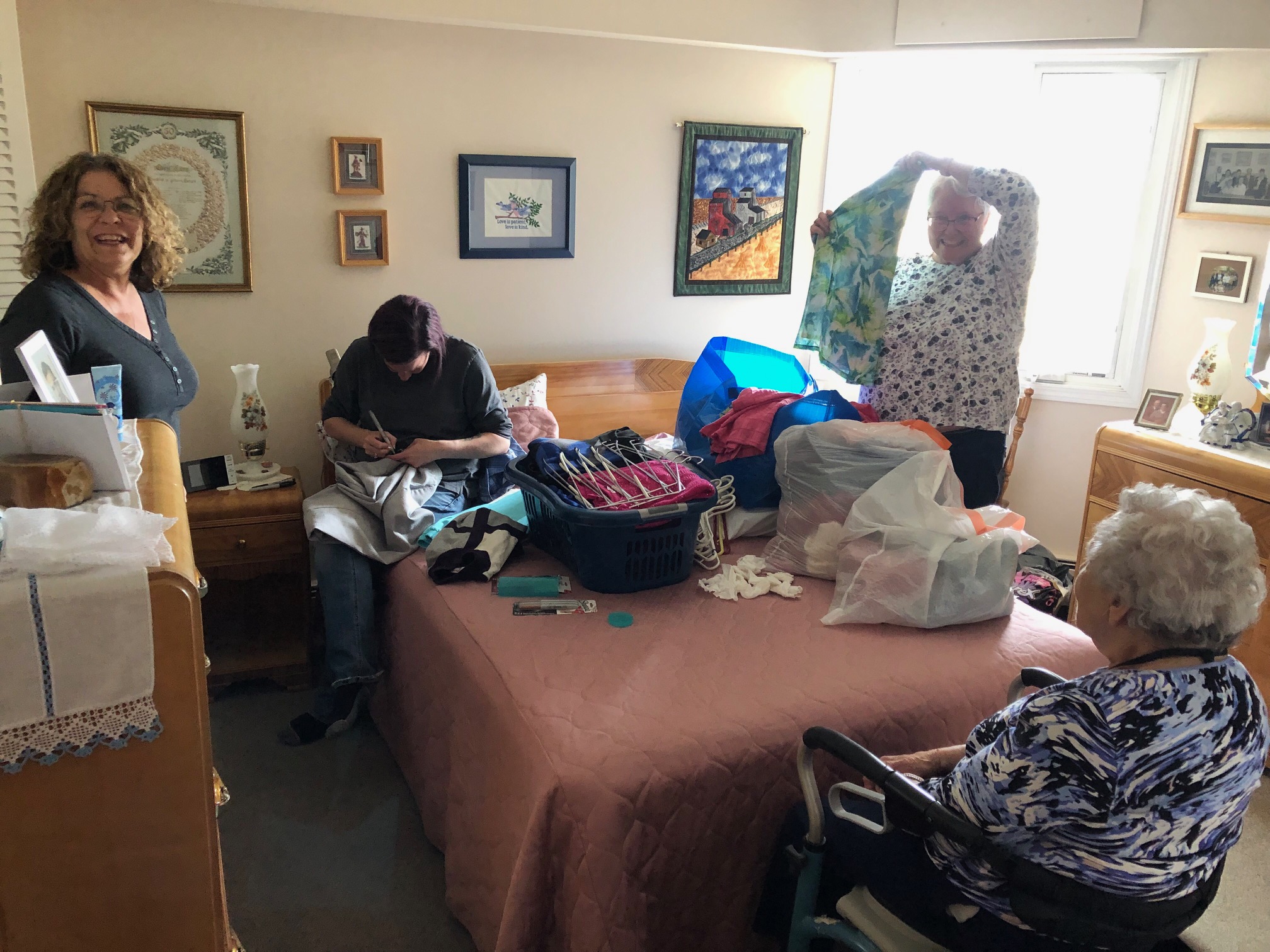
We joined Norma for about 4 or 5 days to help with the move. It was so sad knowing she did not want to leave the tower. She looked defeated. As she told Bill her world keeps getting smaller with each move. Never truer words were spoken. Her new place was just a bedroom with a bed and dresser. She could bring over her clothes and toiletries plus a few pictures, her chair and television. That is where we started. We went through her clothes with her. We had to explain each piece as she could barely see
them. She would feel them. We had to get her to give up a lot of her clothes. She was overwhelmed, sad and had great difficulty deciding. Her silence was heartbreaking. It took a few days to get through it. Then we went on to picking out a few pictures for her new place. That was about all the stuff she could take.
The remaining things, which was everything was up to us to go through. It was either keep and pack it to take home, donate to Goodwill, or put out in the garbage. We had hoped to do this when she was not with us, but it didn't work out this way. Norma had a pretty good handle on those precious things that family members wanted. But then there was “everything else”. Her pantry and fridge had to be disposed of although she was not privy to that. She hadn't cooked in such a long time that things were post dated, stale or just plain questionable. Many of her knick knacks had a story that she shared with us. Her memory is sharp to remember all the stories. Those were very special moments. But mostly she just sat silently in her chair.
Soon as we had sorted through the special things we started on cupboards, drawers, closets etc. She has so much 'stuff'. Every drawer we opened was packed full to the brim. She had letters, documents, among her clothing, shoes and purses. It had to be sorted carefully. It was exhausting for Clara and for us. We filled more than 5 banker boxes with her photo albums and that was not all of them. Jill has them as she wants to go through them and then I will find those photos that will be good for genealogy
and scan them. But I also took 3 or more grocery bags of documents and important things to go through.
By Thursday afternoon we were able to take Clara across the street to her new home. She was sad, anxious and to be honest scared. She was so short of breath by the time she got there it was alarming.
There only about 16 residents in this place and the aide was trying to introduce her to everyone. I had to tell her she couldn't see and hear very well. It was all overwhelming Clara. It was supper time so they got her settled for that and then after supper, Norma took her to her room to help her find where everything was. She was tired and went to bed shortly after that.
We did not get through half of the things in her old place. So much stuff. Don't forget that her furniture had to go too. Norma is going back again before the end of the month to finish clearing it out. Also Norma has been working overtime to get Clara's financial things in place. She has helped close down  the tower apartment and set up the new home. She has set up her prescription blister packs and so so much more business things. I would have to say that Norma was / is taking care of business. It
has been very taxing. When she is back in Saskatoon next week she has to take her mom to a dental and medical appointment. And she is getting more difficult to move about.
By the time, Bill, Jill and I were going home we were overwhelmed and exhausted. Really more mentally than physically. I can't imagine sitting there and watching your stuff being categorized and sent away. The things she surrounded herself for all her life. It was now not needed and not useful. It made me think about what life is all about if this is how it ends up. Jill and I think we should start giving our precious things away now while we are in control. Not a bad idea.
Clara has / had so much stuff and we have so much more.
All I keep saying is, for the love of God get rid of your stuff now.

Wendy

Helping Clara Pick Clothes for Move


One Last Lunch at Luther Tower Dining Room

Bill With His Mother Helping Her out of Her Apartment One Last Time


Sunday, May 12, 2024

52 Ancestors in 52 Weeks Week 18 Prompt - Love and Marriage

2024

52 Ancestors in 52 Weeks

Week 18

Prompt – Love and Marriage

Bill's maternal great-grandparents. Johann Jahnke and Emilie Hein were both born in Bromberg, Posen, Prussia, Germany. Johann Jahnke served his mandatory German military service. He started on 4 Nov 1874 and was discharged 22 Sep 1887. He returned to Bromberg. I do not know how they met. I do know that Johann Jahnke and his brother, Leonhardt Jahnke married twin sisters – Emilie and Amalie Hein. Johann and Emilie married on April 20, 1890. 

Emilie and Johann Jahnke

 April 20, 1890
Bromberg, Prussia

They immigrated to United States and arrived in November 1891. This couple moved from Ulen, Minnesota to Killaly, Saskatchewan to Entwistle, Alberta, to Hatton, Saskatchewan, to Gibbon, Minnesota and finally settling in Yakima, Washington.

They celebrated their Golden Anniversary in Yakima, Washington on April 20, 1940.

Emilie and Johann Jahnke 


 Photographs taken on April 20, 1940.


Emilie and Johann Jahnke


Bill and I were recently helping his mother move into a level 2 nursing home from her apartment. One of the many hanging photos was this beautiful framed 50th Wedding Anniversary commemorative piece. It was a beautiful gift and unfortunately we don't know who had this made for John and Emilie Jahnke. It has embossed silver and gold leaf wreath. Inside the wreath is a Bible verse in German. On the bottom is written Johann Jahnke and Emilie Hein. 1890 – April 20 – 1940. This keepsake had been inherited by Bill's mother, Clara Hoffart from her father, Arthur Jahnke who inherited it from his mother, Emilie Jahnke. 


Wendy


Saturday, May 4, 2024

52 Ancestors in 52 Weeks Week 17 Prompt - War

2024

52 Ancestors in 52 Weeks

Week 17

Prompt – War

Mennonites were conscientious objectors commonly known as “CO's”. Their religion forbid military service or going to war. The Mennonites had signed papers from Canada (1873) accepting their demand of no military service for their men. Not unlike the “school problem”, the Mennonites faced great criticism for being CO's. In 1917 The Military Service Act was in place and demanded compulsory service. Exemptions were ill defined in this Act. Mennonites still had to register, but write Mennonite across the card for exemption purposes. These cards were filled out and signed by the Mennonite minister. Some ministers were less scrupulous than others. Some sold them for money and others just falsified the legitimacy of exemption status.

A tribunal judge was quoted as saying in the Newspaper Clipping from Winnipeg Tribune dated January 4, 1918 had this heading;

“Myers Insists on Mennonites Going To War. Tribunal Judge Avers – They Will Fight if He Can Force Them to Do.”

Judge Myers was also quoted as saying “Their religion is just a cloak to evade military Service. It is not because of their religion, or because they go to any particular church that they want exemption. They just don't want to go.”

In fact on March 28, 1921, “Manitoba Great War Veterans” sent a petition to the federal government wanting to deport all Mennonites and Hutterites who refuse to assume all citizenship in Canada (ie. Military Service).

The Mennonite Military exemption created public backlash and anger all across Canada. The suspicion of these “German – Speaking” aliens was everywhere. There was already a ban on written German publications. Police often observed their church services looking for those who were part of the enemy German people wanting to infiltrate Canada.

Part of the backlash came when Mennonites from the United States starting returning to Canada. United States did not have the military exemption like Canada Mennonites. The government had to put in place an order-in-council to address exactly who would be exempt. The anger, resentment and suspicion was best caught in this newspaper article from Vancouver Daily World dated September 28 1918.


This attitude of distrust and anger persisted for many years. It was not only the Mennonites who were recipients of this, but in general all German Speaking groups. Bill's maternal grandfather and great-grandfather ran a general store in Hatton, Saskatchewan circa 1913. His great-grandfather was John Jahnke who immigrated from Bromberg, Prussia in the 1890's. His son, Arthur Jahnke was born in Winthrop, Minnesota a year after the family immigrated to the States. The family were predominantly German speaking. Eventually they ended up in Hatton, Saskatchewan. John Jahnke opened up a general store called J. Jahnke General Merchandise. A few years later it was bought by son, Arthur and his cousin, Julius Jahnke. The name became A. & J. Jahnke Dry Goods. 

 
Lt to Rt: John, Arthur and Julius Jahnke. Good Day Duck Hunting
John Jahnke was a restless soul and decided to move back to Winthrop, Minnesota. They took a train from Hatton and ended up in Seattle, Washington where he bought a 1916 Maxwell car. Driving in their new car, they explored northern California and ended up in Gibbon, Minnesota where he bought another store. He named this store “Famous”. 

 
I asked Bill's mother why it was not named like his Hatton, Saskatchewan store – J. Jahnke. She told me that this was during the time when Germans were ostracized and he thought it would harm his store business if his name "Jahnke" was included. Thus he chose this. 

Wendy


52 Ancestors in 52 Weeks Week 18 Prompt - Institution

2025  52 Ancestors in 52 Weeks Week 18 Prompt – Institution Daniel Fesser (1844 – 1933). He is Bill's maternal 2 nd great-grandfathe...