Wednesday, April 30, 2025

52 Ancestors in 52 Weeks Week 15 Prompt - Father-in-Law

 2025

52 Ancestors in 52 

Week 15

Prompt - Father-in-Law

Anton Hoffart (Tony)


Birth: January 16, 1923   Minton, Saskatchewan, Canada

Death: August 18, 1992   Saskatoon, Saskatchewan, Canada 

Parents: Rochus Roy Hoffart                                        Marian Hoffart (born Gross)

               1889 - 1970                                                      1892 - 1957


 Siblings:

Eva Clare Berger (born Hoffart); 1915 - 1991

Peter Paul Hoffart; 1917 - 2004

Jacob Joseph Hoffart; 1919 - 1997

Barbara Hornung; 1920 - 2003

John Hoffart; 1925 - 2005

Regina Coupal (born Hoffart); 1927 - 2023

Henry Hoffart; 1929 - 2006 

Wife: Clara Carolina Hoffart (born Jahnke) 1928 - Living

Children:

William Kenneth Hoffart: born 1954

Elaine Patricia Reed (born Hoffart): born 1958

Norma Ruth Armstrong (born Hoffart): born 1963 

March 11, 2018: Elaine, Norma, Clara and Bill 

Biography
Anton Hoffart, also known as Tony, was born on January 16, 1923, in Minton, Saskatchewan, Canada, to Rochus 'Roy' Hoffart and Marian Hoffart (born Gross). His father, Rochus 'Roy', was born on August 14, 1889, in Tulcera, Romania, while his mother, Marian, was born on July 2, 1892. Anton grew up in a large family with six siblings: Eva Clare, Peter Paul, Jacob Joseph, Barbara, John, Regina, and Henry.

October 6, 1932
On October 6, 1952, Anton married Clara Carolina Jahnke, who was born on March 11, 1928, in Killaly, Saskatchewan, Canada. Together, they had three children: William Kenneth, Elaine Patricia, and Norma Ruth.
Anton Hoffart passed away on August 18, 1992, at the age of 69 in Saskatoon, Saskatchewan, Canada. He was buried in Saskatoon, Saskatoon Census Division, Saskatchewan, Canada.

 Last Name Origins
The surname Hoffart is of German origin, derived from the Middle High German word 'hof' meaning 'court' or' farm', combined with 'hart', which means 'hard' or 'strong'. It likely referred to someone who lived near a farmstead or was associated with a stronghold. The name may also have been used as a nickname for someone known for their strength or resilience.

The Hoffart Family, Taken June 23, 2002 

 Wendy


Thursday, April 24, 2025

52 Ancestors in 52 Weeks Week 14 Prompt - Language

2025

52 Ancestors in 52 Weeks

Week 14

Prompt – Language

My ancestors are primarily German. My maternal grandmother and mother's first language was German. However later in their lives they spoke mostly English. My father's first language was German. His parents spoke German and only his father was able to speak a little English. They all immigrated from Prussia (German speaking Russians).

When I first began my genealogy adventure, I had given very little thought to the possibility of looking up German documents from Russia. In 2006 I had to go to the library to find any of the Canadian Census Documents on film to look for my relatives. A census is probably the most basic document to look up and start your genealogy. That is other than any documents you find at home.

Gradually over the past 20 years, genealogy lives have become so much easier with computers and more importantly the download of millions of documents from around the world. The different genealogy sites connect people world wide. Also there is now DNA to bring us closer together. If only I would figure it out! 

Augustine Radler and Julius Jacob Jahnke 
Several years ago while searching records for Bill's 2nd Great-Grandfather – Julius Jacob Jahnke and his wife Augustine Radler from Bromberg, Germany, I was given a hint which turned out to be a completely German Document which was quite difficult to decipher but got the gist it was a Death record. Not only was it in German but written in German Script. There are very few people left who can read the German script writing.  


  Fast forward a few years and re examining the document I found that it had been transcribed into English in the free Latter Day Saints website called Family Tree. I feel that there is more to this document than is transcribed. 

 The German language would make some of my research that reaches back more than a hundred years a lot easier. But as I have seen computers are closing the gap on any language barriers.

Wendy

Tuesday, April 15, 2025

52 Ancestors in 52 Weeks Week 13 Prompt - Home Sweet Home

 2025

52 Ancestors in 52 Weeks

Week 13

Prompt - Home Sweet Home

I had lived in two different homes before the one I remember as the home that I grew up in. I do not remember the first two homes. I do remember 442 Witney Avenue (Saskatoon). It was a brand new home that mom and dad had built. I remember the family was so excited to live in this new home. I also remember going over to look at it during construction.

1959 -  Peters' House Under Construction


1959 - Don and Dennis (Back Row) & Bonnie and Wendy (In Front)


1959 - Robert and Dennis With Workman's Toolbox   


It was fun to run around and in it during this phase. And as I understand it now, that is something not allowed today on new housing builds.

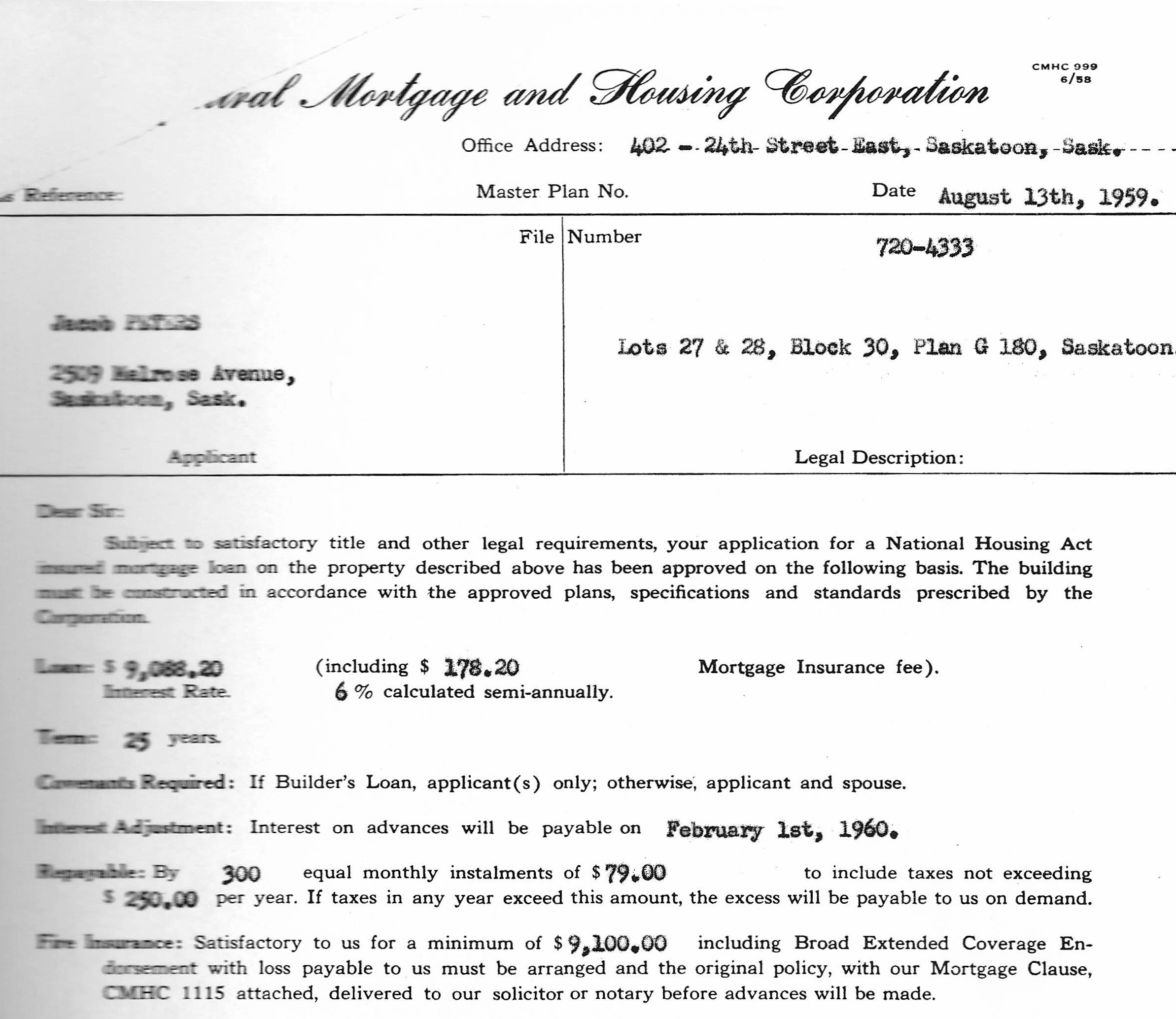
Apparently it was something short of a miracle that they were able to get a mortgage to buy this brand new home. However somehow they got the mortgage and the house was approved for a build in 1959. They signed the “Offer To Purchase and Interim Financing” on May 11, 1959. 

August 1959 my parents received the approval from The Central and Mortgage Housing Corporation.


Thus my parents began their dream of home ownership.The area was close to schools. The high school was 3 blocks away and as we moved into our home they were building a new public school across the street from us. It opened in March of 1960. The neighbourhood was families with lots of children. Beside the school was a paddling pool with a building for indoor fun often lead by high school kids that were either hired or volunteered during the summer months. I have spoke of the outdoor skating / hockey rink just adjacent to the this. At the end of our block was a confectionery (which was a great place to buy penny candies) and a hairdresser. This was the first place that I had my hair done professionally. I believe it was Christmas 1965!

At first the huge back yard was filled with garden which produced a lot of veggies that mom canned and or froze for the hungry family to enjoy during the winter. Over the years the garden was slowly replaced with a flower garden and grass.

In the early years dad flooded the back yard for our own personal backyard skating rink.

Improvements and renovations occurred over the years to the house and yard. It was a very small home of 900 square feet or so with no basement, 3 bedrooms and one bathroom. How did the 9 of us ever work that out. And yet friends of our family were welcome. The more the merrier. During my brother's band playing days mom allowed them to set up in the living room twice each week so they could practise their sets. Drums, organs, guitars, bass guitars and microphones. Yes it was loud. I only remember a few summers of band practise in the garage. I think maybe there may have been more noise complaints on that one.

The house held many many memories – some good and some not so good. It was The Peters home and was where we grew up. We celebrated graduations, marriage celebrations and brought our children home to visit their grandparents. We had yearly Christmas gatherings with various family members attending. 

My parents lived out the rest of their lives in this home. My father died in his home at his request in 1983 and my mother died a widow in January of 1987. The house was sold shortly after my mother died.

Bill and I have driven past it several times over the years while visiting family and friends in Saskatoon. It doesn't seem like the same home. 

Wendy


Thursday, April 3, 2025

52 Ancestors in 52 Weeks Week 12 Prompt - Historical Context

2025

52 Ancestors in 52 Weeks

Week 12

Prompt – Historical Context


Historical Context of David K. Peters - My paternal great-grandfather.

In My Heritage I have once again used the AI (artificial intelligence) to put together a biography based on information in my tree and noted background history. It is impressive and maybe I don't need to write blogs anymore. This is a very scary thought but at the same time quite intriguing to imagine. 


David Klaas K Peters was born in South Russia during a period marked by significant social and political upheaval. The early to mid-19th century saw the Russian Empire grappling with modernization efforts, including the emancipation of serfs in 1861. This era also witnessed the migration of various ethnic groups, including German-speaking settlers who were invited to settle in the Volga and Black Sea regions. These communities often faced challenges related to their cultural identity and economic stability.

Growing up in a large family with 15 siblings, David's upbringing reflected the communal lifestyle prevalent among Mennonite families in South Russia. The Chortitza Colony, where his parents originated, was established as a refuge for these religious minorities seeking freedom from persecution. During this time, the Mennonites maintained strong community ties, emphasizing agricultural practices and pacifism, which shaped David’s values and future decisions.

David married Katharina A P Mueller in 1859, amidst a backdrop of increasing tensions within the Russian Empire regarding minority rights. Their union produced 14 children, indicative of the high birth rates typical of agrarian societies. This demographic trend was common among immigrant populations, reflecting both cultural traditions and the need for labour on farms.

In 1875, David immigrated to Canada, arriving at Quebec City. His decision coincided with a larger wave of immigration driven by factors such as land scarcity, oppressive policies in Russia, and the promise of opportunity in North America. The Canadian government actively encouraged settlement in the West, offering land grants to attract immigrants, particularly those with farming backgrounds like the Mennonites. After settling in various locations across Canada, including Saskatchewan and Manitoba, David became part of the broader narrative of Western expansion in Canada. The late 19th century was characterized by rapid development, with railroads facilitating access to remote areas. However, it was also a time of conflict, particularly between Indigenous peoples and settlers, as well as economic challenges that affected new arrivals trying to establish themselves.

David passed away in 1919, just after World War I, a conflict that had profound effects on global demographics and economies. By this time, many Mennonite communities in Canada had begun to solidify their identities, balancing their heritage with integration into Canadian society. David's life story reflects not only personal resilience but also the broader historical currents of migration, adaptation, and community building in a changing world.

Wendy and AI

Monday, March 31, 2025

52 Ancestors in 52 Weeks Week 11 Prompt - Hobbies

2025

52 Ancestors in 52 Weeks

Week 11

Prompt – Hobbies

I would think that many of the ancestors really didn't have hobbies. All free time was spent working to live. Especially those homesteading on farmland in “the new world”. I believe their time was spent breaking the land, plowing the land, planting, building a home shelter, finding farm animals, building barns or corrals or both. The women would also be very busy at home - preparing food, cooking food, looking after the gardens, preserving the garden produce for winter time and looking after many many children. I suppose that their hobbies would come from necessity. The women might sew materials for clothing or knit sweaters, scarves, hats and mittens and socks. 

1920's ca. Marion Hoffart With Spinning Wheel
Bill's paternal grandmother, Marion Hoffart, had a spinning wheel (made for her by her two oldest sons) to spin the sheep's wool into yarn to knit family clothing as above. Was this a hobby? Maybe. Just like Bill's maternal great-grandfather, Daniel Fesser was by all accounts an excellent carpenter and built many shops and homes in Killaly when he arrived from Germany in the early 1900's. Not really a hobby but a dandy skill set to have when immigrating to a new country.

Fast forward to now. Our lives are quite different from our ancestors. We have so many conveniences that allow us to have free time. I have noticed that the further we go into retirement the more time we seem to have.

Before Bill retired from The College of Arts and Design he became interested in the 3D printers that they had on site. . Bill was not just happy with what the thing could print, but how it worked and thus how it was built. The machines were expensive to buy. Bill searched on line for all the information he could find and before long he was designing and constructing his first 3D printer. He has built 6 of them. He tends to make the newer ones by using the previous printer parts. In the past few months he has begun to build the latest version. Version 7 will be the biggest one. He has explained its workings but I could not even tell you exactly what he was talking about. It is impressive to see it built up. He spends many hours upstairs on the computer designing and re-designing it. He then heads downstairs to his shop and starts to build it. He is not finished but had me go down to his shop an inspect his work His knowledge of such things continues to floor me. He is so happy working on his 3D printer project. It must be a sense of accomplishment; of producing something from nothing. Not unlike his maternal grandmother's spinning wheel and the making of clothing needed for a cold Saskatchewan winter. Or like his paternal great-grandfather making structures where once there was none. A sense of accomplishment and pride in your work. 

March 2025 - Bill Working on 7th Version of 3D Printer


Wendy

Monday, March 17, 2025

52 Ancestors in 52 Weeks Week 10 Prompt - Siblings

2025 

52 Ancestors in 52 Weeks

Week 10 

Prompt - Siblings

Elizabeth Wendel (nee Fesser) is Bill's maternal great-aunt.  That is Bill - Clara Jahnke (mother)  - Ida Bachmann (grandmother) - Wilhelmina Fesser (great-grandmother). Wilhelmina's sister was Elizabeth Fesser. Elizabeth Fesser married Peter Wendel , Elizabeth and Peter immigrated to Canada about 1888 from Galacia, Austria. They married in Winnipeg circa 1892. The 1891 Canada Census has Peter Wendel as a single gentleman living in Winnipeg.  The 1901 census has Peter and Elizabeth Wendel living on a farm in Saltcoats, Saskatchewan. 

I found this photograph in Clara's batch of saved photos and it was named "Wendel Siblings; ca 1915". It took me a little while to figure out who they were in The Hoffart Family Tree.  There was something about the photograph that I liked.

Wendel Siblings ca. 1915.

The descending heights was amazing. They obviously had their children very close together.  I also thought what a lucky man Peter Wendel was to have so many male children to help on the farm. Their oldest child was a female named Wilhelmina and she was born in 1894 meaning she would be 20ish and probably married at the time of this photograph. They also had another daughter named Carolina born in 1898 making her about 17 at the time of this photograph.  She was not married until 1919.  This makes me think that photographing his sons was the main purpose of the photograph. 

Below is a list of their children.   I think from the list that you could match up the names to these children.  I haven't done it.

Parents
 
Peter Wendel

Elizabeth (Lizzie) Wendel   


Wendy

Tuesday, March 11, 2025

52 Ancestors in 52 Weeks Week 9 Prompt - Memory

2025
52 Ancestors in 52 Weeks
Week 9
Prompt – Memory


Bill and I quite enjoy watching curling especially at this time of year when Scotties and Briers Championships are on. Once we did participate in a Bank of Montreal Work gathering one weekend
where we played a “funspiel” between different branches from Saskatchewan. I liken it to a “team building' effort. For a time in the 1970's I worked as a bank employee for one of the branches from Regina. Our team was pretty awful. The only rock that I got over  the hog line,Bill fell on it! We had a banquet and trophy presentations. Our team was presented with the skunk award trophy and we deserved it. The trophy was cute with a little porcelain skunk with a furry tail on top of a pedestal. 

Skunk Trophy
 Sometime during the past week while watching a curling broadcast they played a special interest feature on “Jam Can Curling'.  Well now, I haven't thought of this in a very long time.

 I found a good explanation of this in a Curling Canada Facebook Entry.
“Many books on curling history will tell you that the sport of curling had a boom with participation during the years after World War II. When you look at a lot of curling club-building corner stones, they will read a date from the 1950’s or 1960’s. Adults flocked to the clubs to be part of this rock-throwing craze. Advances in youth programs also took place, with the junior aged youth, those 13 years of age and older. In the majority of cases, youth younger than 13 years were not physically strong enough to
propel the 44 lb. granite stone down the ice. You also have to remember that advances in ice technology were not as refined as they are today, therefore more effort to throw the rock was needed than on the keen ice surfaces of today.
In 1945, the Principal of Lakeview School in Saskatchewan, Harold Covell came up with the idea to have a fun outdoor game by throwing jam cans down a snow cleared ice surface. In those days, jam was bought at the store in cans, about the size of a 2 litre can of paint (okay, I know paint does not come in 2 litre sizes, but for a moment, just imagine). The bottoms of the cans were pounded outward rounding the bottom so the can would slide on the ice. These cans were then filled with concrete to add weight; metal handles were fashioned and stuck in the concrete. When the concrete dried, you now had small rocks that kids of all ages could throw. This was called Jam Can Curling. While it is unknown who can be credited with the idea of jam can stones, these are the grand parents of the rocks we use today. “ 

Historic Jam Cans
In the mid sixties, 1960's that is, I recall spending our phys-ed classes outside on the community's outdoor rink playing “jam can curling”. The outdoor ice was less than flat. Over hill and dale we threw our jam cans to the end of the rink. I do not recall any painted house. Maybe there was just a line that we tried to get over. The weather was bitterly cold as Saskatchewan winters tend to be and no amount of rock throwing warmed you up. That is about the sum total of my memories of “jam can curling”. 

Historic Photo of Backyard Jam Curling Circa 1950's
Apparently today there are numerous “jam pail curling” bonspiels. In Medicine Hat, they celebrated The Sixtieth Anniversary of Jam Pail Curling on February 21, 2025. Children from grade 3-6 plus local residents came together to play off. However today they do not play with jam cans but milk jugs filled
with coloured water which is frozen.


Bill's father belonged to a Saturday night league. Bill said every Saturday evening his father and mom went curling. He couldn't remember if his mom actually curled. Maybe she just enjoyed the beverages and fellowship and an evening out.

1959 Saskatoon Community Curling Team - Tony Hoffart is seated on the left.

 
1965 Saskatoon Community Team With Winning Trophy - Tony Hoffart on the Left.      
Those are my memories of curling in Saskatchewan.

Wendy

52 Ancestors in 52 Weeks Week 18 Prompt - Institution

2025  52 Ancestors in 52 Weeks Week 18 Prompt – Institution Daniel Fesser (1844 – 1933). He is Bill's maternal 2 nd great-grandfathe...