Wednesday, June 4, 2025

52 Ancestors in 52 Weeks Week 18 Prompt - Institution

2025 

52 Ancestors in 52 Weeks

Week 18

Prompt – Institution

Daniel Fesser (1844 – 1933). He is Bill's maternal 2nd great-grandfather. He was born in Theodorshoff, Austria and died in Sedro-Woolley, Washington, United States. 

Daniel and Sophia Fesser With Family Circa 1920 
 In 2019, Week 6, I blogged about Daniel Fesser. I was trying to find his grave. I never did find a grave site at The Northern State hospital or grounds in Sedro-Woolley, Washington. Although he was cremated and possibly buried or lost or well endless scenarios. If you want to know those details please refer back to that blog.

Northern State Hospital was a “mental institution”. I often wondered how Daniel Fesser ended up in the hospital. Daniel Fesser was 40 years older than his second wife, Sophia Schechtel. He was admitted November 7, 1931. He died August 4, 1933 of pneumonia with the contributing factor listed as “senile dementia”. I just surmised that at 86 he probably had dementia and was perhaps too hard to take care of by his younger wife with 4 children.

A few weeks back while going through my Ancestry Genealogy hints, I came across a new one for Daniel Fesser. The hint came from Washington State, U.S. Newspapers.com and in particular this article was printed in The Bellingham Herald on October 30, 1931. The topic was Accidents or Emergency Incidents. 

8 days after this incident he was admitted to The Northern State Hospital. No doubt he had dementia and needed to be cared for in the hospital. It was amazing to me to find this newspaper article. Even more so is the fact that it was newsworthy to be printed. However at this time it was not unusual to find such articles in local papers. I am thankful for these articles because they help shed light on my ancestors in a way that otherwise would not have been known.

Wendy


Sunday, May 11, 2025

52 Ancestors in 52 Weeks Week 17 Prompt - Oldest

2025

52 Ancestors in 52 Weeks

Week 17

Prompt – Oldest

In my search for my oldest dated photograph, I came across this one. 

April 20, 1890 - Emilie and Johann Jahnke Wedding Portrait
Bill's maternal great-grandfather was Johann Friedrich Jahnke.

His story comes from an oral history given to my sister-in-law by her grandfather, Arthur Jahnke, about his memories of his father, mother and brother. The history was given in January of 1976. That is almost 50 years ago. Imagine if my sister-in-law had not written this history. So many of the anecdotes would be missing.

Johann Friedrich Jahnke was born on November 25 ,1863, in Bromberg Stadt, Posen, Prussia.

His father Julius Jacob Jahnke was born circa 1837, in Prussia, Germany.

His mother Augusta Radel was born on August 15 1834, in Germany.

He was baptized on December 21 1863, in Bromberg Stadt, Posen, Prussia.

He had 4 siblings: Leonhard Heinrich, Louise Carolyn, Bertha and Mathilde Albertine.

Johann Jahnke began his 3 year compulsory German Military Service on Nov 7,1884. He completed it on Sep 7, 1887.

His wife Ernestine Emilie Hein / Heyn was born on April 29 1857, in Bromberg Stadt, Posen, Prussia.

They were married on April 20 1890, in Bromberg, Prussia, and they had 2 sons: Leonhard Ferdinand (born in Prussia) and Arthur Jahnke (born in Winthrop Minnesota).

Johann Jahnke and his family departed from Antwerp, Belgium on the Ship - Belgenland and arrived in Philadelphia, Pennsylvania, United States on 9 Nov 1891.

After immigration in November of 1891, they settled in Winthrop, Minnesota, United States.

After 4 or so years, Johann Jahnke and his family moved (by covered wagon) 350 miles away to Ulen, Minnesota in 1896 where he bought a farm and built a two story frame house using only a hatchet and a saw.

In the spring of 1903 Johann Jahnke and his family immigrated to Killaly, Northwest Territories (now Saskatchewan). This move was made by train. Emilie and Arthur went as passengers and Johann and Leonhard went as freight in order to stay with the horses, cows and machinery. He paid $10.00 for his homestead of a 1/4 section. He started to build a wooden frame house buying the lumber from the proceeds of the sale of his farm in Ulen. He seeded his first crop in 1905 and then in 1906 he bought another 1/4 section of land.

In 1911 Johann Jahnke sold his farm in Killaly and bought land in Entwistle, Alberta. This was in order to help his oldest son, Leonhard start on his homestead.

In 1912, after a failed homestead in Northern Alberta, Johann and his family then moved to Hatton, Saskatchewan which was 20 miles north of Maple Creek. Johann built a general store and another frame house.

In 1916, Johann Jahnke decided to move back to Winthrop, Minnesota. He sold his store to his son Arthur and Arthur's cousin Julius Jahnke. However instead the family took the train to Seattle to make a trip of it. Once in Seattle he bought a 1916 Maxwell and started to explore California north and eventually ended up in Gibbon, Minnesota and bought another store.

In 1926 Johann Jahnke sold his Gibbon store and moved to Regina, Saskatchewan.

We next pick up Johann and Emilie Jahnke listed in a 1929 City directory for the city of Yakima, Yakima, Washington.

In 1935, he lived at the same house - 603 No 5th Ave, Yakima, Precinct 9, Yakima, Washington, USA.

In 1938 Johann Friedrich Jahnke became a naturalized citizen of United States signing the Oath in November, 1938.

In the 1940 U.S. Census it is written that he lives at 603 No 5th Ave, Yakima,  Precinct 9, Yakima, Washington, USA.

April 20, 1940 - Emilie and Johann Jahnke's 50th Wedding Anniversary
Johann Jahnke passed away on February 3 1945, at age 81 in Yakima, Washington, USA

Emilie Jahnke died April 5, 1946 in Yakima, Washington.

I was told by mother-in-law, Clara Hoffart, many years ago that Johann did indeed have an “itchy foot”. She knew that if he had not been so sick that he would have likely moved again from Yakima, Washington. 

Wendy


Saturday, May 3, 2025

52 Ancestors in 52 Weeks Week 16 Prompt - Golden

 2025

52 Ancestors in 52 Weeks

Week 16

Prompt - Golden

50 Years Ago Today

May 3, 1975 - Bill and Wendy Hoffart 


Wendy and Bill

Wednesday, April 30, 2025

52 Ancestors in 52 Weeks Week 15 Prompt - Father-in-Law

 2025

52 Ancestors in 52 

Week 15

Prompt - Father-in-Law

Anton Hoffart (Tony)


Birth: January 16, 1923   Minton, Saskatchewan, Canada

Death: August 18, 1992   Saskatoon, Saskatchewan, Canada 

Parents: Rochus Roy Hoffart                                        Marian Hoffart (born Gross)

               1889 - 1970                                                      1892 - 1957


 Siblings:

Eva Clare Berger (born Hoffart); 1915 - 1991

Peter Paul Hoffart; 1917 - 2004

Jacob Joseph Hoffart; 1919 - 1997

Barbara Hornung; 1920 - 2003

John Hoffart; 1925 - 2005

Regina Coupal (born Hoffart); 1927 - 2023

Henry Hoffart; 1929 - 2006 

Wife: Clara Carolina Hoffart (born Jahnke) 1928 - Living

Children:

William Kenneth Hoffart: born 1954

Elaine Patricia Reed (born Hoffart): born 1958

Norma Ruth Armstrong (born Hoffart): born 1963 

March 11, 2018: Elaine, Norma, Clara and Bill 

Biography
Anton Hoffart, also known as Tony, was born on January 16, 1923, in Minton, Saskatchewan, Canada, to Rochus 'Roy' Hoffart and Marian Hoffart (born Gross). His father, Rochus 'Roy', was born on August 14, 1889, in Tulcera, Romania, while his mother, Marian, was born on July 2, 1892. Anton grew up in a large family with six siblings: Eva Clare, Peter Paul, Jacob Joseph, Barbara, John, Regina, and Henry.

October 6, 1932
On October 6, 1952, Anton married Clara Carolina Jahnke, who was born on March 11, 1928, in Killaly, Saskatchewan, Canada. Together, they had three children: William Kenneth, Elaine Patricia, and Norma Ruth.
Anton Hoffart passed away on August 18, 1992, at the age of 69 in Saskatoon, Saskatchewan, Canada. He was buried in Saskatoon, Saskatoon Census Division, Saskatchewan, Canada.

 Last Name Origins
The surname Hoffart is of German origin, derived from the Middle High German word 'hof' meaning 'court' or' farm', combined with 'hart', which means 'hard' or 'strong'. It likely referred to someone who lived near a farmstead or was associated with a stronghold. The name may also have been used as a nickname for someone known for their strength or resilience.

The Hoffart Family, Taken June 23, 2002 

 Wendy


Thursday, April 24, 2025

52 Ancestors in 52 Weeks Week 14 Prompt - Language

2025

52 Ancestors in 52 Weeks

Week 14

Prompt – Language

My ancestors are primarily German. My maternal grandmother and mother's first language was German. However later in their lives they spoke mostly English. My father's first language was German. His parents spoke German and only his father was able to speak a little English. They all immigrated from Prussia (German speaking Russians).

When I first began my genealogy adventure, I had given very little thought to the possibility of looking up German documents from Russia. In 2006 I had to go to the library to find any of the Canadian Census Documents on film to look for my relatives. A census is probably the most basic document to look up and start your genealogy. That is other than any documents you find at home.

Gradually over the past 20 years, genealogy lives have become so much easier with computers and more importantly the download of millions of documents from around the world. The different genealogy sites connect people world wide. Also there is now DNA to bring us closer together. If only I would figure it out! 

Augustine Radler and Julius Jacob Jahnke 
Several years ago while searching records for Bill's 2nd Great-Grandfather – Julius Jacob Jahnke and his wife Augustine Radler from Bromberg, Germany, I was given a hint which turned out to be a completely German Document which was quite difficult to decipher but got the gist it was a Death record. Not only was it in German but written in German Script. There are very few people left who can read the German script writing.  


  Fast forward a few years and re examining the document I found that it had been transcribed into English in the free Latter Day Saints website called Family Tree. I feel that there is more to this document than is transcribed. 

 The German language would make some of my research that reaches back more than a hundred years a lot easier. But as I have seen computers are closing the gap on any language barriers.

Wendy

Tuesday, April 15, 2025

52 Ancestors in 52 Weeks Week 13 Prompt - Home Sweet Home

 2025

52 Ancestors in 52 Weeks

Week 13

Prompt - Home Sweet Home

I had lived in two different homes before the one I remember as the home that I grew up in. I do not remember the first two homes. I do remember 442 Witney Avenue (Saskatoon). It was a brand new home that mom and dad had built. I remember the family was so excited to live in this new home. I also remember going over to look at it during construction.

1959 -  Peters' House Under Construction


1959 - Don and Dennis (Back Row) & Bonnie and Wendy (In Front)


1959 - Robert and Dennis With Workman's Toolbox   


It was fun to run around and in it during this phase. And as I understand it now, that is something not allowed today on new housing builds.

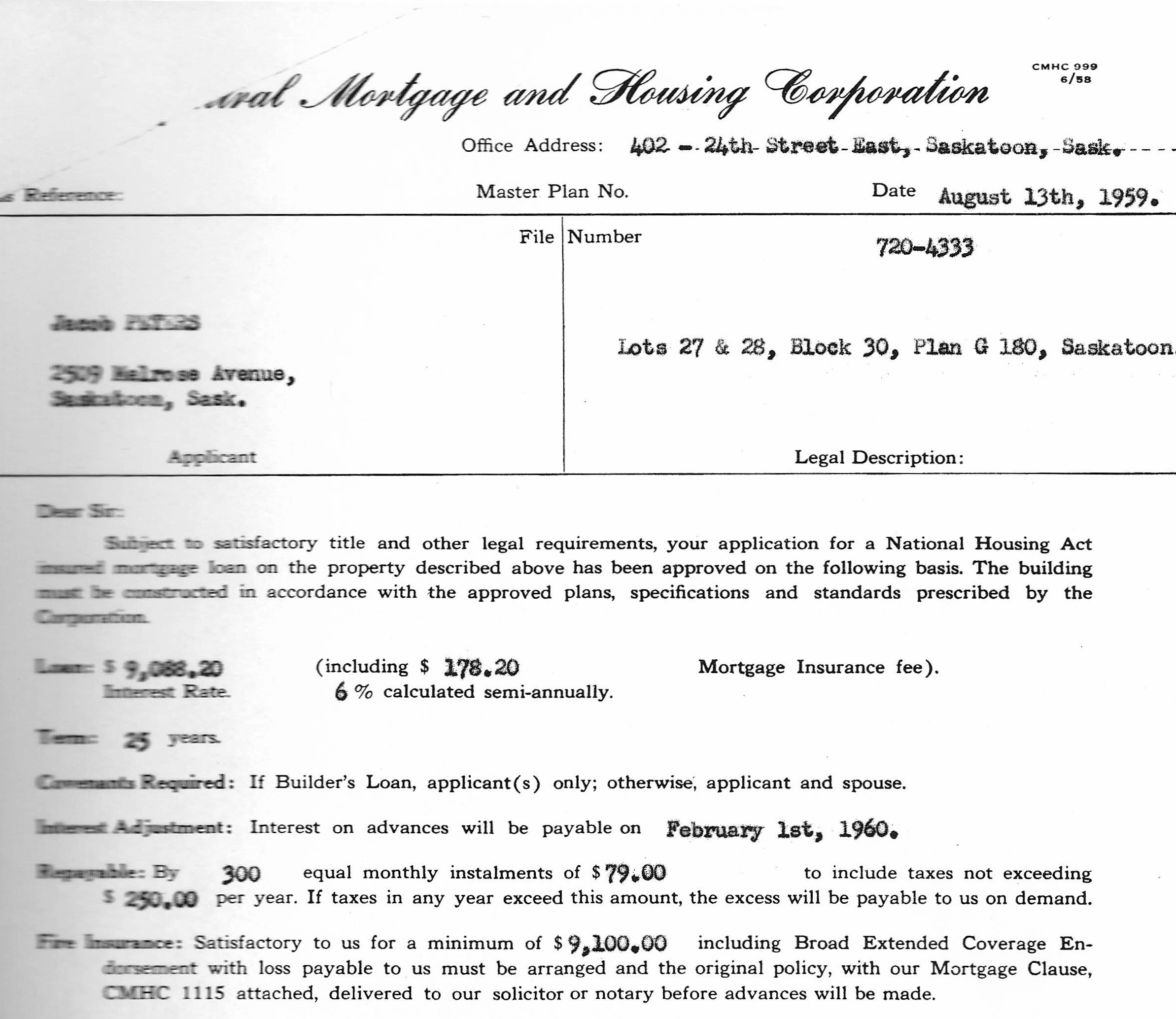
Apparently it was something short of a miracle that they were able to get a mortgage to buy this brand new home. However somehow they got the mortgage and the house was approved for a build in 1959. They signed the “Offer To Purchase and Interim Financing” on May 11, 1959. 

August 1959 my parents received the approval from The Central and Mortgage Housing Corporation.


Thus my parents began their dream of home ownership.The area was close to schools. The high school was 3 blocks away and as we moved into our home they were building a new public school across the street from us. It opened in March of 1960. The neighbourhood was families with lots of children. Beside the school was a paddling pool with a building for indoor fun often lead by high school kids that were either hired or volunteered during the summer months. I have spoke of the outdoor skating / hockey rink just adjacent to the this. At the end of our block was a confectionery (which was a great place to buy penny candies) and a hairdresser. This was the first place that I had my hair done professionally. I believe it was Christmas 1965!

At first the huge back yard was filled with garden which produced a lot of veggies that mom canned and or froze for the hungry family to enjoy during the winter. Over the years the garden was slowly replaced with a flower garden and grass.

In the early years dad flooded the back yard for our own personal backyard skating rink.

Improvements and renovations occurred over the years to the house and yard. It was a very small home of 900 square feet or so with no basement, 3 bedrooms and one bathroom. How did the 9 of us ever work that out. And yet friends of our family were welcome. The more the merrier. During my brother's band playing days mom allowed them to set up in the living room twice each week so they could practise their sets. Drums, organs, guitars, bass guitars and microphones. Yes it was loud. I only remember a few summers of band practise in the garage. I think maybe there may have been more noise complaints on that one.

The house held many many memories – some good and some not so good. It was The Peters home and was where we grew up. We celebrated graduations, marriage celebrations and brought our children home to visit their grandparents. We had yearly Christmas gatherings with various family members attending. 

My parents lived out the rest of their lives in this home. My father died in his home at his request in 1983 and my mother died a widow in January of 1987. The house was sold shortly after my mother died.

Bill and I have driven past it several times over the years while visiting family and friends in Saskatoon. It doesn't seem like the same home. 

Wendy


Thursday, April 3, 2025

52 Ancestors in 52 Weeks Week 12 Prompt - Historical Context

2025

52 Ancestors in 52 Weeks

Week 12

Prompt – Historical Context


Historical Context of David K. Peters - My paternal great-grandfather.

In My Heritage I have once again used the AI (artificial intelligence) to put together a biography based on information in my tree and noted background history. It is impressive and maybe I don't need to write blogs anymore. This is a very scary thought but at the same time quite intriguing to imagine. 


David Klaas K Peters was born in South Russia during a period marked by significant social and political upheaval. The early to mid-19th century saw the Russian Empire grappling with modernization efforts, including the emancipation of serfs in 1861. This era also witnessed the migration of various ethnic groups, including German-speaking settlers who were invited to settle in the Volga and Black Sea regions. These communities often faced challenges related to their cultural identity and economic stability.

Growing up in a large family with 15 siblings, David's upbringing reflected the communal lifestyle prevalent among Mennonite families in South Russia. The Chortitza Colony, where his parents originated, was established as a refuge for these religious minorities seeking freedom from persecution. During this time, the Mennonites maintained strong community ties, emphasizing agricultural practices and pacifism, which shaped David’s values and future decisions.

David married Katharina A P Mueller in 1859, amidst a backdrop of increasing tensions within the Russian Empire regarding minority rights. Their union produced 14 children, indicative of the high birth rates typical of agrarian societies. This demographic trend was common among immigrant populations, reflecting both cultural traditions and the need for labour on farms.

In 1875, David immigrated to Canada, arriving at Quebec City. His decision coincided with a larger wave of immigration driven by factors such as land scarcity, oppressive policies in Russia, and the promise of opportunity in North America. The Canadian government actively encouraged settlement in the West, offering land grants to attract immigrants, particularly those with farming backgrounds like the Mennonites. After settling in various locations across Canada, including Saskatchewan and Manitoba, David became part of the broader narrative of Western expansion in Canada. The late 19th century was characterized by rapid development, with railroads facilitating access to remote areas. However, it was also a time of conflict, particularly between Indigenous peoples and settlers, as well as economic challenges that affected new arrivals trying to establish themselves.

David passed away in 1919, just after World War I, a conflict that had profound effects on global demographics and economies. By this time, many Mennonite communities in Canada had begun to solidify their identities, balancing their heritage with integration into Canadian society. David's life story reflects not only personal resilience but also the broader historical currents of migration, adaptation, and community building in a changing world.

Wendy and AI

Monday, March 31, 2025

52 Ancestors in 52 Weeks Week 11 Prompt - Hobbies

2025

52 Ancestors in 52 Weeks

Week 11

Prompt – Hobbies

I would think that many of the ancestors really didn't have hobbies. All free time was spent working to live. Especially those homesteading on farmland in “the new world”. I believe their time was spent breaking the land, plowing the land, planting, building a home shelter, finding farm animals, building barns or corrals or both. The women would also be very busy at home - preparing food, cooking food, looking after the gardens, preserving the garden produce for winter time and looking after many many children. I suppose that their hobbies would come from necessity. The women might sew materials for clothing or knit sweaters, scarves, hats and mittens and socks. 

1920's ca. Marion Hoffart With Spinning Wheel
Bill's paternal grandmother, Marion Hoffart, had a spinning wheel (made for her by her two oldest sons) to spin the sheep's wool into yarn to knit family clothing as above. Was this a hobby? Maybe. Just like Bill's maternal great-grandfather, Daniel Fesser was by all accounts an excellent carpenter and built many shops and homes in Killaly when he arrived from Germany in the early 1900's. Not really a hobby but a dandy skill set to have when immigrating to a new country.

Fast forward to now. Our lives are quite different from our ancestors. We have so many conveniences that allow us to have free time. I have noticed that the further we go into retirement the more time we seem to have.

Before Bill retired from The College of Arts and Design he became interested in the 3D printers that they had on site. . Bill was not just happy with what the thing could print, but how it worked and thus how it was built. The machines were expensive to buy. Bill searched on line for all the information he could find and before long he was designing and constructing his first 3D printer. He has built 6 of them. He tends to make the newer ones by using the previous printer parts. In the past few months he has begun to build the latest version. Version 7 will be the biggest one. He has explained its workings but I could not even tell you exactly what he was talking about. It is impressive to see it built up. He spends many hours upstairs on the computer designing and re-designing it. He then heads downstairs to his shop and starts to build it. He is not finished but had me go down to his shop an inspect his work His knowledge of such things continues to floor me. He is so happy working on his 3D printer project. It must be a sense of accomplishment; of producing something from nothing. Not unlike his maternal grandmother's spinning wheel and the making of clothing needed for a cold Saskatchewan winter. Or like his paternal great-grandfather making structures where once there was none. A sense of accomplishment and pride in your work. 

March 2025 - Bill Working on 7th Version of 3D Printer


Wendy

Monday, March 17, 2025

52 Ancestors in 52 Weeks Week 10 Prompt - Siblings

2025 

52 Ancestors in 52 Weeks

Week 10 

Prompt - Siblings

Elizabeth Wendel (nee Fesser) is Bill's maternal great-aunt.  That is Bill - Clara Jahnke (mother)  - Ida Bachmann (grandmother) - Wilhelmina Fesser (great-grandmother). Wilhelmina's sister was Elizabeth Fesser. Elizabeth Fesser married Peter Wendel , Elizabeth and Peter immigrated to Canada about 1888 from Galacia, Austria. They married in Winnipeg circa 1892. The 1891 Canada Census has Peter Wendel as a single gentleman living in Winnipeg.  The 1901 census has Peter and Elizabeth Wendel living on a farm in Saltcoats, Saskatchewan. 

I found this photograph in Clara's batch of saved photos and it was named "Wendel Siblings; ca 1915". It took me a little while to figure out who they were in The Hoffart Family Tree.  There was something about the photograph that I liked.

Wendel Siblings ca. 1915.

The descending heights was amazing. They obviously had their children very close together.  I also thought what a lucky man Peter Wendel was to have so many male children to help on the farm. Their oldest child was a female named Wilhelmina and she was born in 1894 meaning she would be 20ish and probably married at the time of this photograph. They also had another daughter named Carolina born in 1898 making her about 17 at the time of this photograph.  She was not married until 1919.  This makes me think that photographing his sons was the main purpose of the photograph. 

Below is a list of their children.   I think from the list that you could match up the names to these children.  I haven't done it.

Parents
 
Peter Wendel

Elizabeth (Lizzie) Wendel   


Wendy

Tuesday, March 11, 2025

52 Ancestors in 52 Weeks Week 9 Prompt - Memory

2025
52 Ancestors in 52 Weeks
Week 9
Prompt – Memory


Bill and I quite enjoy watching curling especially at this time of year when Scotties and Briers Championships are on. Once we did participate in a Bank of Montreal Work gathering one weekend
where we played a “funspiel” between different branches from Saskatchewan. I liken it to a “team building' effort. For a time in the 1970's I worked as a bank employee for one of the branches from Regina. Our team was pretty awful. The only rock that I got over  the hog line,Bill fell on it! We had a banquet and trophy presentations. Our team was presented with the skunk award trophy and we deserved it. The trophy was cute with a little porcelain skunk with a furry tail on top of a pedestal. 

Skunk Trophy
 Sometime during the past week while watching a curling broadcast they played a special interest feature on “Jam Can Curling'.  Well now, I haven't thought of this in a very long time.

 I found a good explanation of this in a Curling Canada Facebook Entry.
“Many books on curling history will tell you that the sport of curling had a boom with participation during the years after World War II. When you look at a lot of curling club-building corner stones, they will read a date from the 1950’s or 1960’s. Adults flocked to the clubs to be part of this rock-throwing craze. Advances in youth programs also took place, with the junior aged youth, those 13 years of age and older. In the majority of cases, youth younger than 13 years were not physically strong enough to
propel the 44 lb. granite stone down the ice. You also have to remember that advances in ice technology were not as refined as they are today, therefore more effort to throw the rock was needed than on the keen ice surfaces of today.
In 1945, the Principal of Lakeview School in Saskatchewan, Harold Covell came up with the idea to have a fun outdoor game by throwing jam cans down a snow cleared ice surface. In those days, jam was bought at the store in cans, about the size of a 2 litre can of paint (okay, I know paint does not come in 2 litre sizes, but for a moment, just imagine). The bottoms of the cans were pounded outward rounding the bottom so the can would slide on the ice. These cans were then filled with concrete to add weight; metal handles were fashioned and stuck in the concrete. When the concrete dried, you now had small rocks that kids of all ages could throw. This was called Jam Can Curling. While it is unknown who can be credited with the idea of jam can stones, these are the grand parents of the rocks we use today. “ 

Historic Jam Cans
In the mid sixties, 1960's that is, I recall spending our phys-ed classes outside on the community's outdoor rink playing “jam can curling”. The outdoor ice was less than flat. Over hill and dale we threw our jam cans to the end of the rink. I do not recall any painted house. Maybe there was just a line that we tried to get over. The weather was bitterly cold as Saskatchewan winters tend to be and no amount of rock throwing warmed you up. That is about the sum total of my memories of “jam can curling”. 

Historic Photo of Backyard Jam Curling Circa 1950's
Apparently today there are numerous “jam pail curling” bonspiels. In Medicine Hat, they celebrated The Sixtieth Anniversary of Jam Pail Curling on February 21, 2025. Children from grade 3-6 plus local residents came together to play off. However today they do not play with jam cans but milk jugs filled
with coloured water which is frozen.


Bill's father belonged to a Saturday night league. Bill said every Saturday evening his father and mom went curling. He couldn't remember if his mom actually curled. Maybe she just enjoyed the beverages and fellowship and an evening out.

1959 Saskatoon Community Curling Team - Tony Hoffart is seated on the left.

 
1965 Saskatoon Community Team With Winning Trophy - Tony Hoffart on the Left.      
Those are my memories of curling in Saskatchewan.

Wendy

Tuesday, February 25, 2025

52 Ancestors in 52 Weeks Week 8 Prompt - Letters

2025

52 Ancestors in 52 Weeks

Week 8

Prompt – Letters

This is a letter written by Bill's maternal grandmother, Ida Anna Jahnke (nee; Bachmann). She wrote this congratulatory letter on the occasion of the birth of Bill's younger sister, Norma Ruth Hoffart. Norma was born on 7 Jul 1963.

Ida and Arthur Jahnke lived in the small town of Killaly, Saskatchewan. Killaly is 367 Kms. Southeast of Saskatoon. Bill feels that his grandparents moved off of their Killaly farm into the town in the early 1950's. Bill's parents were married in Killaly and then moved to Saskatoon right after their honeymoon. Clara had told me that her mother mailed her a letter every week after they moved to Saskatoon. I asked her what she wrote about and she said anything and everything. Weather, small town gossip and church news. Clara went on to say it was one of her greatest regrets that she threw them out. I felt a pang of regret as well. There would be so much information in those letters.

Among the photographs, cards, and documents of Clara I found the following letter.


  I never knew that in 1963, Ida and Arthur Jahnke did not have a phone of their own. Winnie was Clara's best friend and her bridesmaid and lived across the street from Ida and Arthur Jahnke. I am not sure what she meant about the mail not being the same and if I was to guess I believe all mail would have reached it's destination within 1 day and that was not happening then.

January 8th was a Monday. It was sweet that Ida and Arthur were ready to go to Saskatoon to help if needed or just to visit the newest granddaughter. I'm impressed that she let Clara decide on when she should come.

Being farmers the inclusion of weather information in relation to how the crops and gardens are doing would be very appropriate. It has been so long since I thought about picking berries. She would put up her preserves based on what they could find “in the wild” so to speak.

Clara did tell me that the whole family loved fishing. So it was not surprising that they caught fish when out for a few hours. I learned that Ida could catch fish easily and knew how clean them. I'm sure that would have been a few meals for them. She ordered the eggs from her son-in-law's farm. It never occurred to me how self sufficient they were. I guess living in a small town within acres of farmland would make it that easy. It wasn't a chore but more of a result of a fun outing.

I haven't thought about hanging clothes out to dry in a very long time. Not that I ever did that but mom did. Brought back many wonderful memories such as playing with clothespins and bringing in frozen clothes in the winter time.

The Doreen she talks about is Ida's daughter-in-law. Her husband was Ida's son and he died of Cancer in 1962. So at this time Doreen would have been between her two marriages. She had 3 daughters. Doreen and Bill's mother were quite close. Doreen's maiden name is Graff. Ida must have wanted to let Clara know about Doreen's parents news of moving into a house after selling their business. Small town where everybody know everybody. Or small town gossip.

Churches and religion in general were a big thing for this family and i might add probably for most of the town. Ida and Arthur's home was right behind the church property. as Bill says just across the ditch. I found it funny that she was relieved that the Summer Vacation Bible School was at the school and therefor the noise would be much less near her home.

I know how much Bill's family loved to dance. They were good at it too. I still can't get my head wrapped around the connection to the bride but then in a small community I think there would be many people at a wedding and dance who knew each other.

I think the farm where she was going to look after her potatoes and cabbages had to be Ida and Arthur's old farm. As I understand, Doreen and then husband Herb (who died of Cancer in 1962) were owners of the farm. So I gather she would have made a supplemental garden at that farm.

So as Clara said her mother would write about anything and everything. Bill's grandmother, Ida Jahnke died in Oct of 1972. Bill and I were just starting to date. I never had a chance to meet her. I would have loved to. This letter gives me a glimpse into a few days of her life in July of 1963. 

June 1967 Arthur and Ida Jahnke on 50th Anniversary


Wendy


Monday, February 17, 2025

52 Ancestors in 52 Weeks Weeks 6 & 7 Prompt - Surprise

2025

52 Ancestors in 52 Weeks

Weeks 6 & 7

Prompt – Surprise

Robert and Mary Sullivan - 11 Apr 1921
Twenty some years ago I started genealogy to find out who my biological maternal grandfather was. At the time my siblings and I knew him as “Pat Sullivan”. And various other derogatory names. My mother and indeed my grandmother chose never to speak of him. We knew he was of Irish descent. Mary and Pat had two children – my mother (born 1922) and a boy who died in infancy in January of 1927. Actually I did not know about the boy who died in infancy until my sister told me about him.

Sometime after their infant died they parted. The family folk lore was that he was a bigamist while married to my grandmother. They charged him and he was sent to Stony Mountain Penitentiary. The lore went on to say that while he worked as a chef on a train that travelled between Winnipeg (where Pat and Mary lived) and Saskatoon, he had a wife at each end. It was an interesting story. And for my first 10 years I found no evidence to support this story. I was speaking to my grandmother's daughter-in-law lamenting how I could not find anything to prove this story and told her I surmised that it was just family folk lore. She was more than adamant that it was true and I should continue to look.

In 2007 I ordered a genealogical copy of Mary and Pat's Wedding from Manitoba. I learned from this certificate that he was “Bob Windsworth Sullivan” and was 29 years old in 1921 when they married. Thus his birth-date would be circa 1892. The certificate said he was born in Pittsburgh, PA. His father was William Sullivan born in Dublin, Ireland and his mother was Mathilda Olteri. That was all new information and yet in my searches I never found a family with their names and Pat as a son. His second name, Windsworth was new to me but because it was so different I was sure it would help find him.

In 2010 my aunt Phyllis sent me all of the papers, photographs and certificates of grandmother for me to keep. The only thing I found was the church certificate of their marriage and it had been ripped in half. Again information on the church certificate was slightly different from the genealogical copy I had. It listed him as Robert Windsworth Sollivan (with an O) and my grandmother was listed as Mary Krikow instead of Krikau.

A year or two later I found a Robert Wentworth Sullivan in a British Columbia on-line death index. I decided to order it. When I got it I could not determine whether it was my grandfather or someone else. Some of the information was the same and some was not. His birth-date was listed as May 29, 1887 and that he was born in Truro, Nova Scotia, Canada. I put it aside and it wasn't until 2015 or so that I looked at it again and I was still not sure that he was my biological grandfather.

In 2017 I was working on my mother's genealogy I decided to order her birth certificate from Manitoba. When I received it I was in for quite a surprise. On my mother's official notice of birth her father was listed as Patrick Sullivan and his residence was listed as “Stony Mountain Penitentiary”. His profession is listed as “prisoner”. It also said he was born in Los Angeles, California – his 3rd place of birth. However the stunning surprise was that he was in jail. The family legend or folk lore was true. What the heck! I was so sure that it was not true.

Fast forward to spring of 2020. I had subscribed to Newspaper.com. It is a compilation of newspapers from around the world. It is a very fascinating read even if you are not looking for some specific article. In the search I entered Pat Sullivan and was surprised with an article dated 10 Apr 1922 in The Winnipeg Tribune. Another piece of his puzzle came up.

The Winnipeg Tribune wrote all about Patrick Sullivan and his excuse for marrying a second women while still married to my grandmother. He was given a 2 year sentence.

As the family story goes on, grandmother forgave him and took him back and they relocated to Saskatoon. In the fall of 1924 they had their second child and this son only lived a few months. Sometime after that they parted ways. At the time I could not find a divorce record for them but just put it down to the times and no need for divorces. My grandmother remarried 1 Apr 1932.

This made we wonder if Robert W Windsworth ever remarried.

In 1921 while I was perusing my newspaper.com which I do from time to time I put in a search for Robert W Sullivan. What I discovered was an announcement of his wedding to a “Jean Walker” in Saskatoon on 7 Aug 1930. The first thing was the name of Jean Walker because as it turns out that is the name of his spouse mentioned on his 1952 death certificate. And secondly this proves without a doubt that the Robert W Sullivan who died in Chilliwack is indeed my biological grandfather. One more piece of the puzzle was solved.

Since then I had decided that this was all that I would ever find for him. I have been looking into his life pre-marriage to my grandmother. Things such as, where exactly was he born and exactly when. When did he come to Canada?

A few weeks ago I had been notified by Artificial Intelligence (AI) that Robert Sullivan had another hint to check out. This was in my Ancestry family tree. I quickly looked at it and saw the words “bigamist” and thought 'oh yes I know about this already.' A day or two later I decided to look at the newspaper's articles to check it out. The Saskatoon newspaper date was Jan 1928. Wait a minute, I thought, that is not the same as the Winnipeg newspaper article of  April 1922. 

5 Jan 1928 - Saskatoon Daily Star
This is about my grandmother and grandfather, Mary and Robert Windsworth Sollivan. He also had an alias – Paddy Southland!

Mrs. Mary Sollivan accused him of marrying another women in March of the previous year, in 1927. And her name was Jean Walker. Oh my how the plot thickens. This is the woman that he eventually marries in 1930. And I guess in March of 1927. They remanded him in the Saskatoon Cells until Friday morning.

The next article was written on 6 Jan 1928 – Friday.


On the 3rd page and across the top in bold enlarged type

In this article we learn so much more information. The second marriage to Jean Walker was 8 Mar 1927. His first incarceration in Winnipeg was 10 Apr 1922 when he bigamously married a Pearl Tuson. We learned that he was an American who has been in Canada about 20 years. Mr Sullivan offered an excuse for his 1st bigamous marriage that he was intoxicated, doped and robbed. His excuse for his 2nd bigamous marriage that he understood his wife had gone to America, married another man and had a child. Thus he didn't expect to see him again.

It was picked up by no less than 4 newspapers across Canada. It was newsworthy. No wonder my grandmother never wanted to talk about him and her marriage to him.


Jan 7, 1928 The Ottawa Journal 

Jan 7, 1928 The Vancouver Sun 


Jan 7 1928 - The Edmonton Journal
The last newspaper article I had was the announcement of Grandmother's divorce. Dated 6 Oct 1928 from Saskatoon Star where it says Mrs. Sollivan was granted a “decree nisi”. 


Wikipedia explains this way: “A decree nisi or rule nisi (from Latin nisi 'unless') is a court order that will come into force at a future date unless a particular condition is met. Unless the condition is met, the ruling becomes a decree absolute (rule absolute), and is binding.”

In my opinion I believe this was her divorce from Robert Sullivan. These articles provided surprising information I had never heard of.  It provided some clarification on the time line of Mary and Robert Sullivan after parting ways in 1925 until Robert Sullivan remarries in 1930. I now know he was an American and that as of 1928 had lived in Canada for 20 years. I can start looking for immigration / border crossings around this time.

Piece by surprising piece I am learning about my maternal biological grandfather – Robert Wentworth Sullivan. By the time I hang up my genealogy laptop I hope to find out where he was born and when his real birth-date was and when did he come into Canada. Who were his parents and did he have siblings? It would be a bonus to find out more details of his time during these years.

Call me surprised!!!!

Wendy


52 Ancestors in 52 Weeks Week 18 Prompt - Institution

2025  52 Ancestors in 52 Weeks Week 18 Prompt – Institution Daniel Fesser (1844 – 1933). He is Bill's maternal 2 nd great-grandfathe...